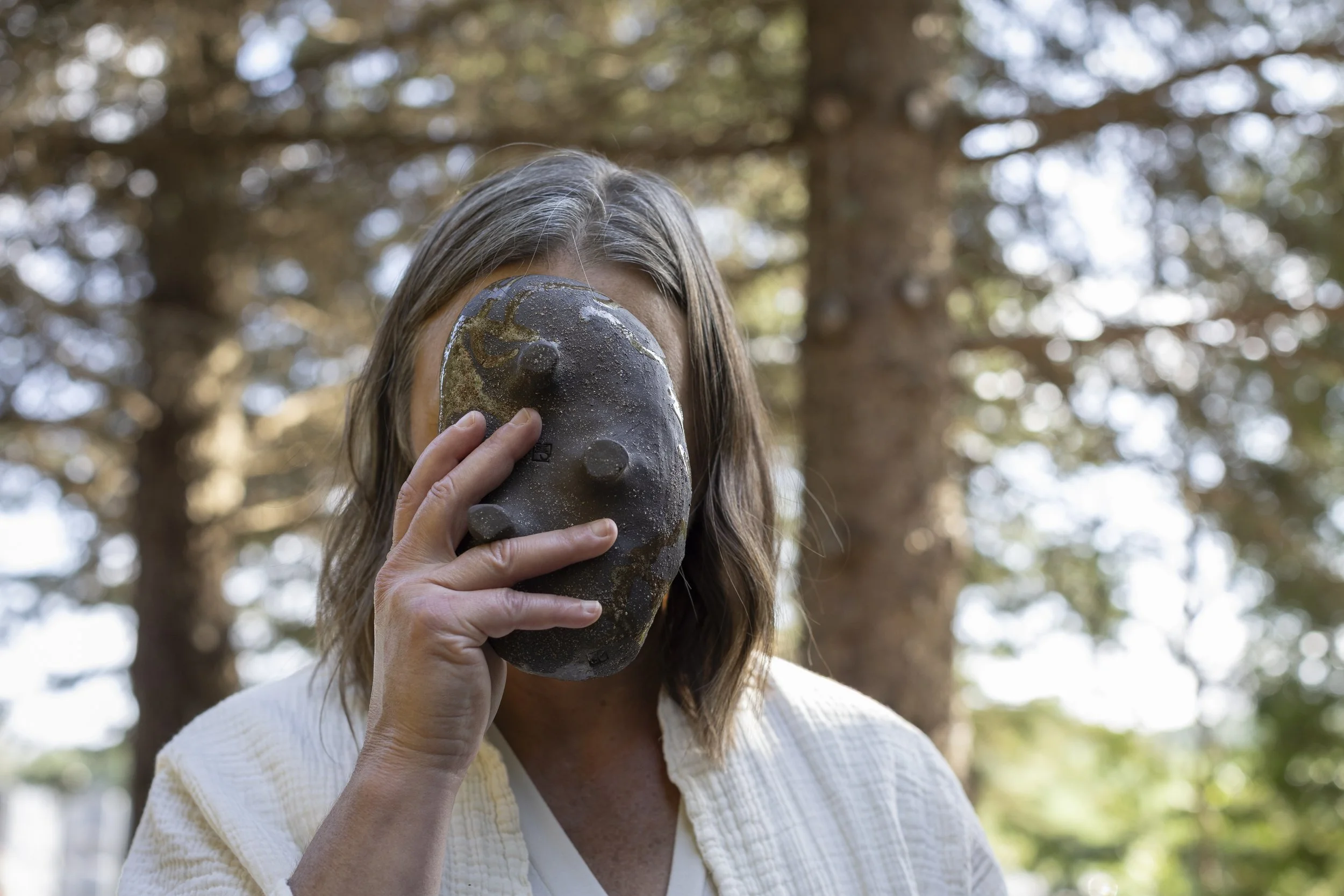
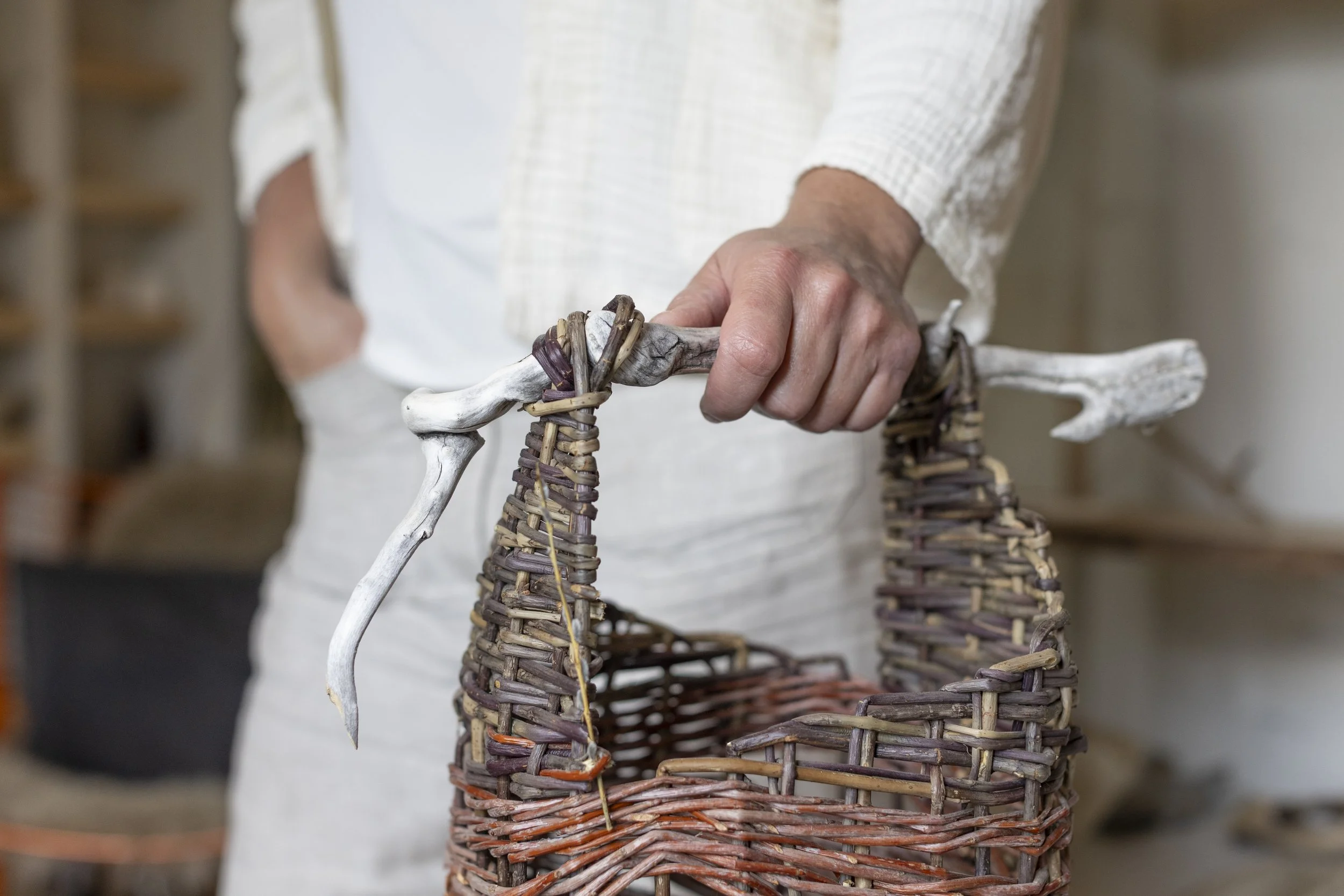
Working across ceramics and fibre, Jamila creates sculptural vessels that explore material, place and our relationship with the natural world.
Clay is often combined with foraged and found materials, bringing traditional ceramic processes into conversation with contemporary basketry.
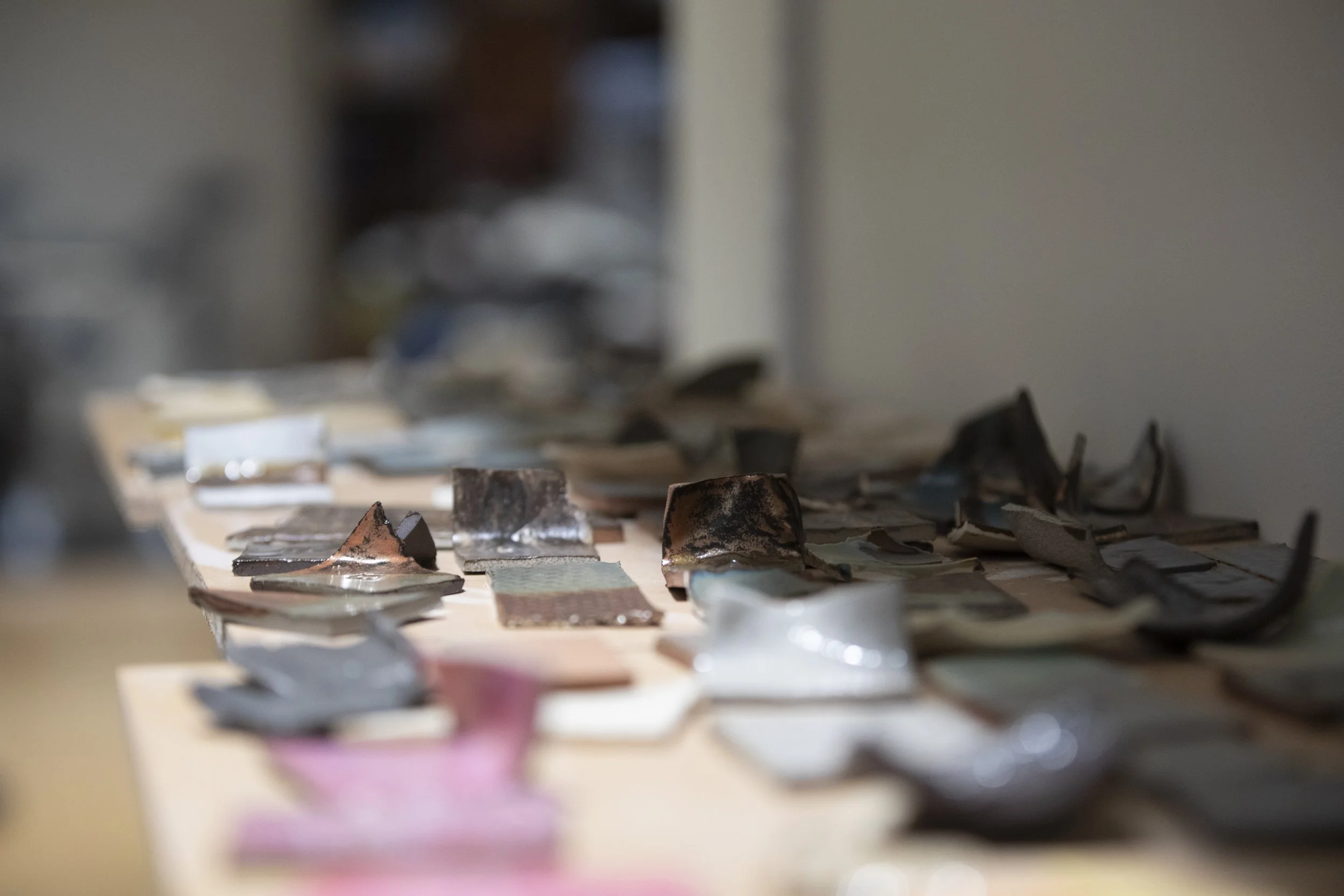
Each body of work begins with a close attention to material and landscape, considering what the land holds, how it changes, and the traces we leave behind.
Sculptural Vessels
Functional Pottery

9” H x 21” D
Paper string, spent winter milkweed pods, hand-spun milkweed string.
Simple ingredients, neutral colour palette, structured yet organic- just like the natural world, especially in Canadian winter.
This piece was made in the liminal time between Xmas and New Year’s,
as a return to see what’s possible after a time in hospital. It sat finished - but yet incomplete - until recently. I awoke in the night and knew that it needed the softness of the milkweed silk in a single cord of strength, that tied it all together.
By reaching out to community and the land with intentions of reciprocity and an understanding that all flourishing is mutual, I learned: how to use a drop spindle, collect milkweed fibres, spread the seeds back to the land from which it came and make 14ft of two ply milkweed yarn.
And now it feels done.
In these times and world of uncertainty, I call this piece ‘Hope’ and intentionally return my gaze to the natural world that arises each day with love, reciprocity and resilience.
May it bring you the hope you need as well.
Xo

24x20”
Slab-built stoneware ceramic bark base, Foraged roots, Willow bark, Reed cane stained with roasted dandelion tea.
This work is an ode to the liminal—the threshold spaces where transformation quietly unfolds. It emerges from a dialogue between material and memory, where clay, reed, bark, and roots are shaped by human hands yet remain deeply tethered to their origins. Through the interweaving of ceramics and natural fibers, I explore the tension between permanence and impermanence, structure and softness, containment and expansion.
Liminal space, to me, is not only a physical condition but a psychological pull—a subtle invitation into the in-between. It is the suspended moment at dawn when light hesitates between night and day, the shifting boundary where land dissolves into water, or the fragile balance between ice, liquid, and air. These thresholds hold a quiet charge: they are familiar yet estranged, grounding yet disorienting. They ask us to linger in uncertainty.
The forms in this work echo those experiences. Fired clay vessels suggest stability, weight, and the human desire to hold and define. In contrast, woven elements—constructed from reed, bark, and root—remain porous, flexible, and alive with irregularity. Together, they create hybrid structures that neither fully enclose nor fully release. They exist as intermediaries, mirroring landscapes such as shorelines, forest edges, and other ecotones where one world gives way to another.
By manipulating natural materials, I am not attempting to dominate them, but to collaborate with their inherent tendencies. The clay remembers pressure and heat; the fibers retain the gestures of growth and decay. These materials carry their own histories of transformation, and in bringing them together, I aim to honour the quiet, continuous act of becoming.
This work invites viewers into a contemplative threshold—a space that resists resolution. It is a place of pause, where the known softens and the unknown begins to take shape. In this suspension, there is both unease and possibility. The liminal is not empty; it is charged with potential, holding the energy of change and the quiet promise of what comes next.

18”D x 5”H
Hand textured stoneware bowl; Food safe glaze.
An ode to the shorelines and shoals of Georgian Bay. The Potholes, Vernal Pools and the geological features of the Canadian Shield. Where water meets land and ancient rock, weathered and transformed to textural wonderlands of complexity and depth. Like trying to define the differentiation between shoreline and waterline, this piece blurs the line between function and fine art. May this sculptural vessel also bring you much joy as a functional bowl for display or serving. Made of high fired stoneware and glass-like glaze, this piece will last a lifetime and age as gracefully as the shoreline it represents.

Wheel-thrown and Hand Altered Grey Stoneware clay:Double Fired- Highfired and then Smoke Fired with raw natural materials
14"x8"
This piece was born from big feelings. Created during the devastating ice storm of spring 2025, the scene and sounds outside my studio echoed like a war zone—trees breaking, branches shattering, the landscape transformed. Inside, working in the semi-darkness with only the hum of a generator for power, I felt compelled to throw something large on the wheel. Big clay, big gestures, big emotion.
I began documenting the process without knowing where the clay would lead. As the form emerged, it revealed itself as a tree—first a tall trunk, then fractured, bulbous, and altered. Like the storm-ravaged landscape outside my home, the piece became a reflection of brokenness and resilience.
This work is an ode to the beauty of imperfection, to the wabi-sabi spirit that lives in both the natural world and the act of creation. It honors the trees—broken yet enduring—that continue to stand as witnesses to loss and renewal

Hand-formed Stoneware Clay base, food safe quail egg glaze, locally foraged Red Osier Dogwood and Wild Willow, Canadian Arctic Driftwood.
10x10x19”
This piece draws inspiration from the landscapes of the Yukon and the natural materials that root us to place. Its organic form recalls the movement of rivers—channels that carve through the land and through our lives, shaping terrain while carrying and holding what is left behind.
Driftwood collected from Atlin Lake, on the Yukon–British Columbia border, serves as both material and marker of place, becoming a vessel of memory that connects the work to the landscape from which it was gathered. Dogwood and Wild Willow, ethically foraged closer to home, extend this dialogue with nature, while the stoneware base draws influence from both the bedrock of the Niagara Escarpment and the delicate markings of quail eggs from my homestead.
Sculptural yet functional, the work reflects the duality inherent in nature itself: enduring and ever-changing, rooted and in motion.

26"H x 23"W x 3"D
Stoneware clay, Onoclea sensibilis (Sensitive Fern) fronds, Wire, Paper twine, Palm inflorescence, Reed.
Hand-formed in stoneware clay and assembled with materials gathered close to home—along the Niagara Escarpment and the shores of Georgian Bay—as well as from travels abroad, this work explores the idea of home as something we carry within us.
Conceived as a compass, the piece reflects the ways our hearts guide us toward places of belonging. Rather than pointing north, it points inward, reminding us that home is found through memory, connection, and the landscapes that shape us.
All Directions Pointe Home is an ode to summers spent on the shores of Georgian Bay and a tribute to the enduring pull of Pointe au Baril. It honours the places that become part of us, suggesting that no matter where life leads, every direction has the potential to point us home.
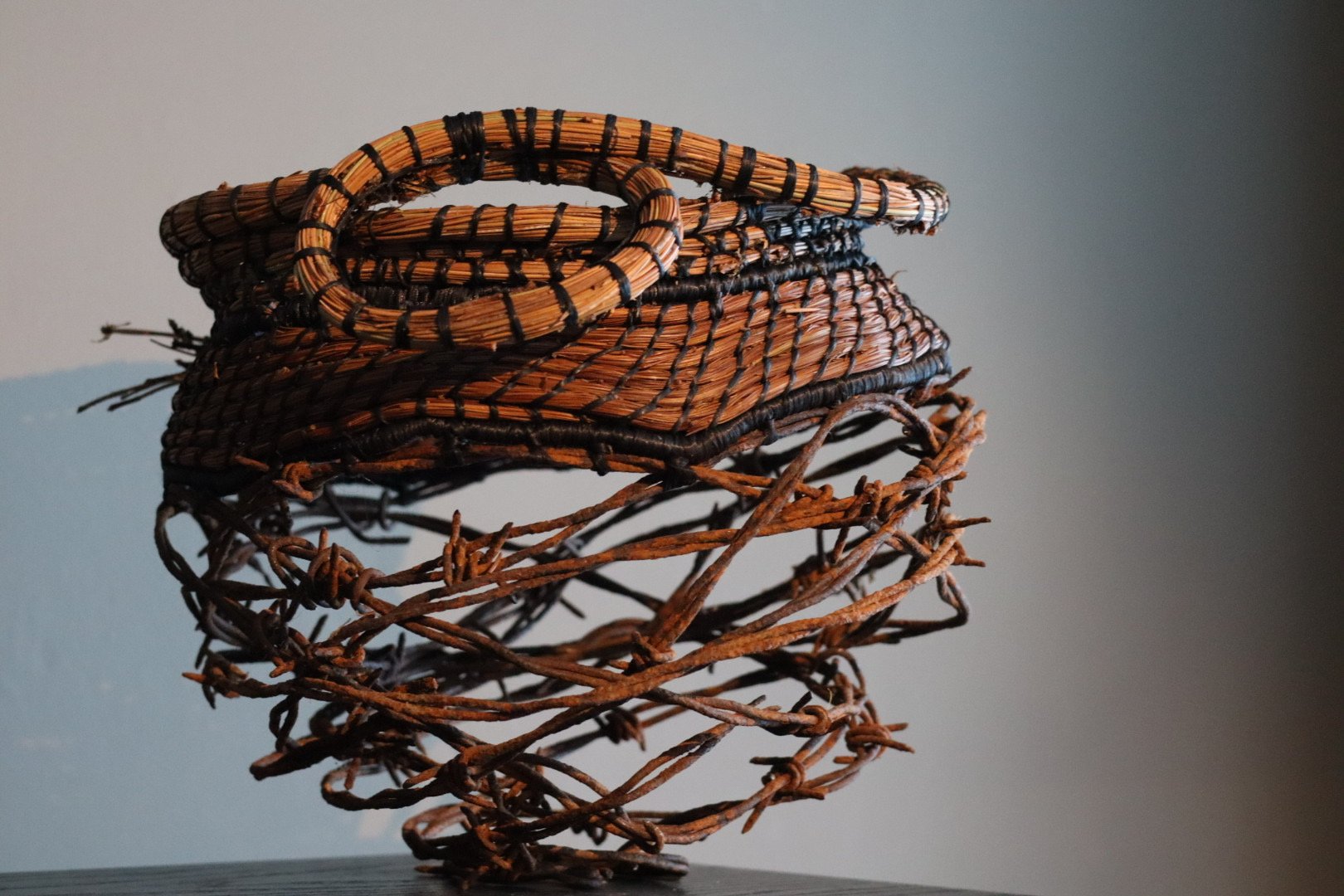
8”x11”
White Pine and Red Pine needles; Waxed Linen thread; Barbed Wire (ethically foraged)
Deeply drawn to natural materials, these mediums allowed me to reconnect with my creativity through a sense of place, while learning to slow down and engage with the world in a new way. Through my art, I aim to inspire others to reflect on our relationship with the natural world and our shared place within it.
The resilience of the natural world is a continual source of wonder for me. This work explores the ways in which nature adapts to the intrusions of humankind—embracing, transforming, and ultimately encompassing what is left behind. Where we leave obstacles, nature sees opportunities: to shift, to grow, and to weave beauty around the detritus of our presence. In its quiet persistence, it teaches me to listen more deeply and to attend with greater care.
As a someone who lives with chronic pain, this piece also reflects the adaptation and resilience required to work with it. The structural barbed wire can be seen to represent my skeletal pain and the pine needles the softening and fine balance needed to live with it. Each stitch a perseverance to live fully and creatively.
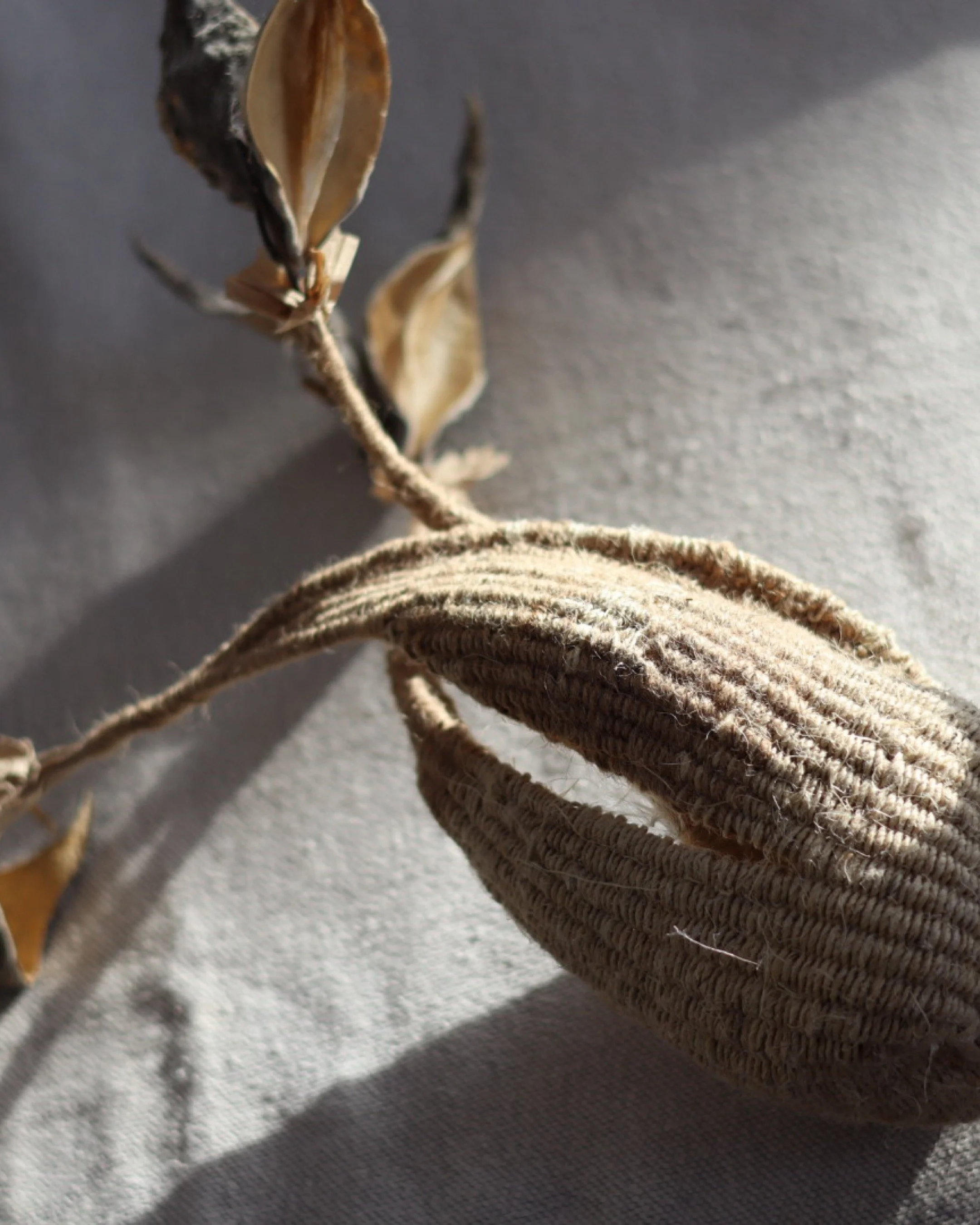
Paper Twine, Hemp Cord, Natural Jute, Milkweed.
16x5x5”
Contemporary basketry inspired by the winter milkweed pods that stand in the windswept fields behind my home on the Niagara Escarpment. In their weathered elegance, I see both fragility and endurance — sculptural forms that hold the promise of renewal. These pods shelter the seeds of spring and carry the hope for the Monarch butterfly’s return, their cycle of life continuing against all odds. Through my work, I seek to honour these quiet forms as symbols of resilience, transformation, and the interconnection between land, species, and seasons.
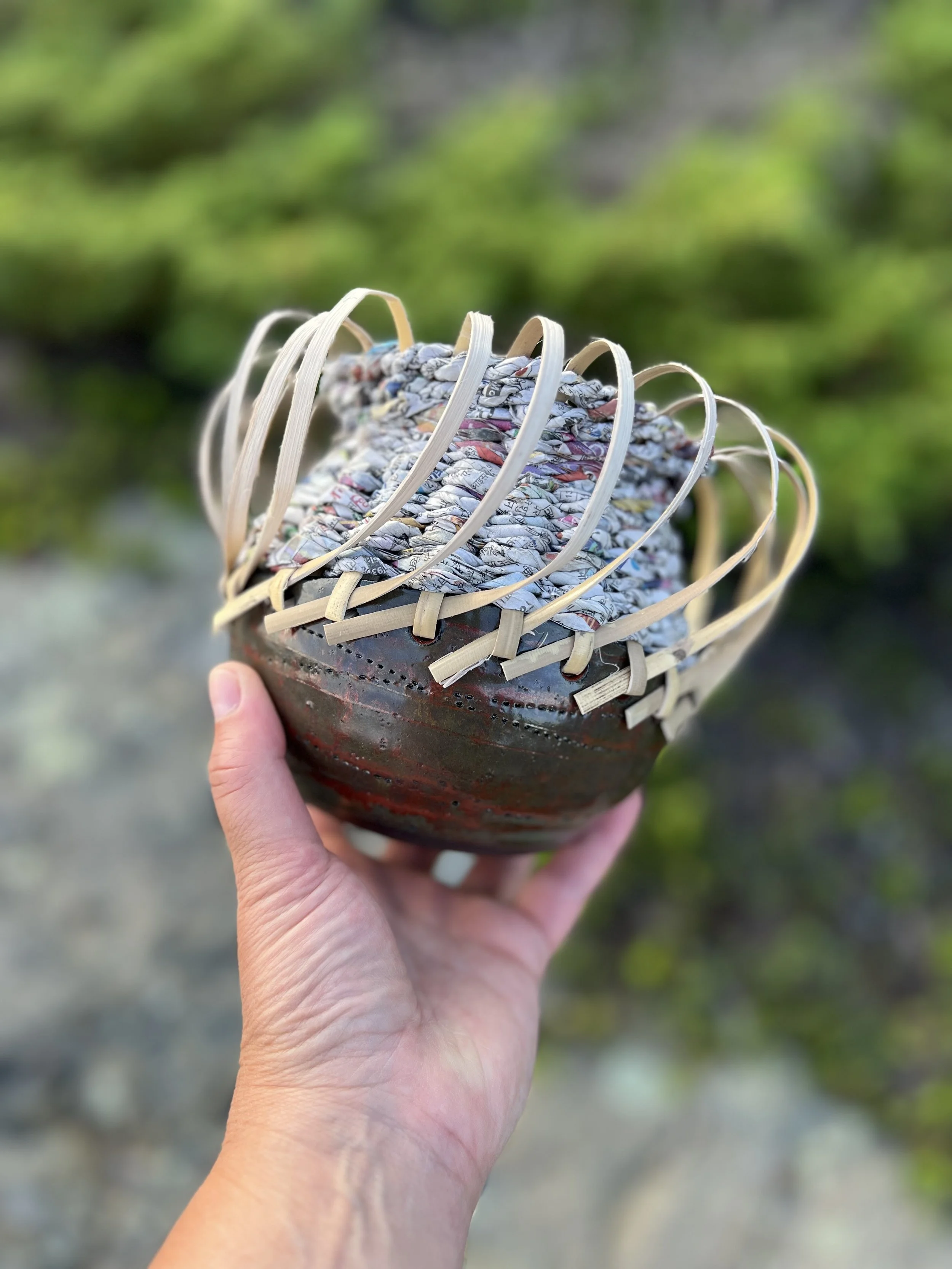
Wheel-thrown Stoneware Clay base, Twined Cordage made from Southeast Asian Newspaper and Rattan Peel.
H5.5'"xW8.5”
Blood, sweat, and tears. This work, in a ‘Study of Losses’, reflects on the cyclical nature of the fast fashion industry—its erosion of craftsmanship, its exploitation of cheap overseas labour, and the human cost woven into every seam.
At first glance, the vessel presents harmony and beauty, yet closer inspection reveals its fractures. Red glaze seeps through the stitching at the base, evoking countless pinpricks of blood. Wrapped within the collar, newspaper fragments speak of unrest, echoing the voices of labour movements and the struggle against unjust working conditions.
The use of rattan—a fast-growing material native to Southeast Asia—ties the work back to its origins, circling us through the story again. Like fast fashion itself, the cycle is unrelenting: desire, consumption, loss. This piece asks us to confront what is hidden beneath the surface and to question the fleeting fulfillment we seek in what cannot last.
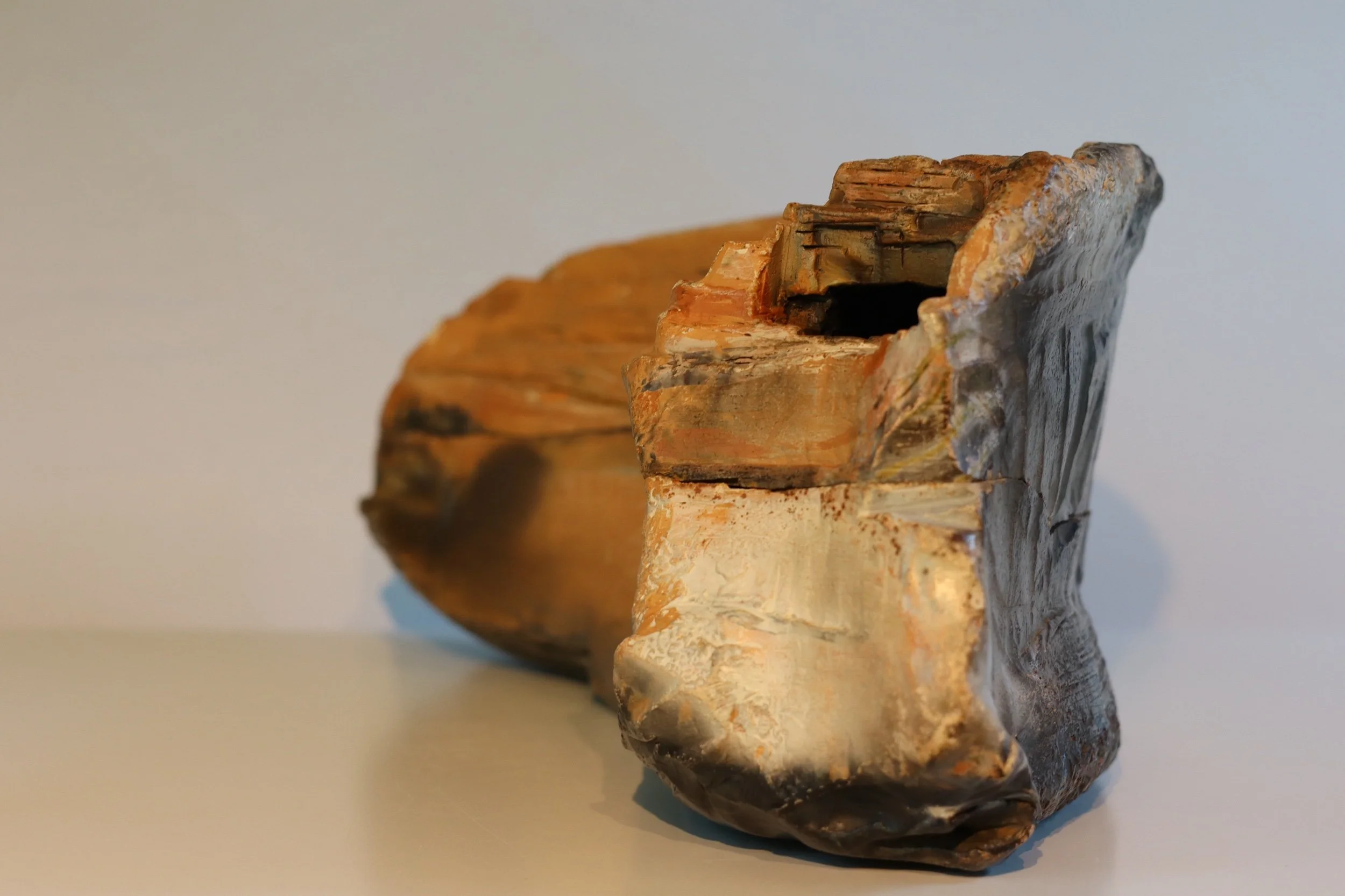
Listening
Smoke-fired Raku clay; Wild foraged clay for Terra Sigillatas; Invasive plant materials; Found and discarded metals and minerals.
22”L x 7”H x 7”W
This vessel carries the memory of place and the ability to listen to the land and its peoples.
Its surface holds wild clays I personally harvested by canoe along the Yukon River, alongside clay gifted to me by Indigenous leaders of The Long Ago People’s Place—an honour I hold with profound gratitude and humility.
Within its fractured surface are layers of story: Tutchone First Nations knowledge of the land, my lived experience as a settler, and a shared responsibility to care for Turtle Island. The vessel becomes a meeting place between these experiences—not to speak for one another, but to listen deeply and acknowledge the relationships, histories, and responsibilities that connect us.
Smoke firing deepens this dialogue, transforming earth, fire, air, and time into a surface that cannot be entirely controlled. The marks left behind become evidence of process, place, and change.
Rocks are not just rocks. They are the Earth’s memory keepers—holding chemistry, history, and the conditions that sustain life.
Through clay, I seek to listen, remember, and participate in acts of reconciliation in action—where art becomes a way of honouring place, relationship, and responsibility.
[e(ART)h]
The Fracture Lines Collection
This collection explores material memory, environmental erosion, and the things we carry through life—both visible and invisible. Fracture Lines grew from a deep connection to the landscapes that have shaped me, and from a growing awareness of how much we hold within ourselves: memory, grief, love, loss, resilience, and hope.
Each hand-carved vessel was created through Kurinuki, a traditional Japanese technique of hollowing solid blocks of clay. Each form slowly excavated into being, echoing geological shifts and the landscapes that have shaped my sense of place.
The surfaces are layered with Terra Sigillatas made from foraged clays, allowing the land itself to become part of the work. Minerals, metals and invasive plants introduced during a 24-hour smoke firing then leave unpredictable marks, embracing chance, transformation, and the alchemy of fire.
These vessels hold more than form. They hold traces of place, process, and our enduring connection to the earth. Their fractures remind us that what breaks us, also shapes us—and that there can be beauty, strength, and tenderness in what we carry forward.
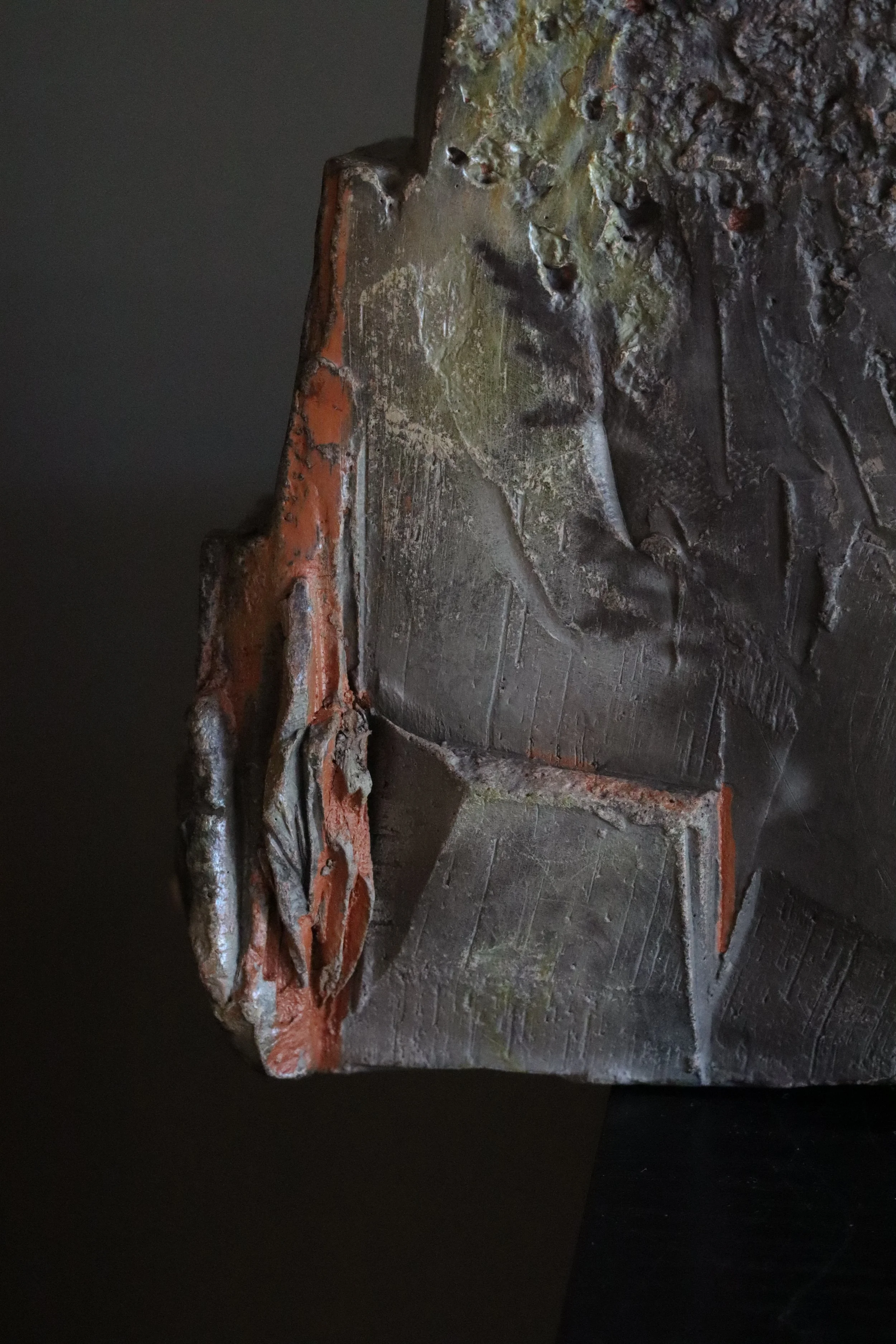
Smoke Fired Raku Clay using Wild Foraged Clay for Terra Sigillata, Kurinuki Technique
A Smoke Fired Series from the Study of Losses Exhibition
Fault Line
What is Left Behind
Below the Surface
Overburden
Ledge- 13” x 7” x 3”
My work investigates material memory, environmental erosion, and our evolving relationship with the land. Fracture Lines consists of hand-carved vessels created through Kurinuki, a traditional Japanese technique of hollowing solid clay blocks. Each form began as 25–50 pounds of Raku clay, slowly excavated into being, echoing the landscapes and geologic shifts I reference.
The surfaces are layered with Terra Sigillatas made from foraged and local clays, embedding the mineral signatures of place. Copper, steel wool, and native plants were introduced during firing, producing chemical reactions that left unpredictable marks. A final 24-hour smoke firing completed the transformation, embracing chance and the alchemy of fire.
The series reflects on fractures—geologic, ecological, and human-made. It speaks to the visible and invisible disruptions we impose on ecosystems, particularly the fragile balance of water and stone within the Canadian Shield and Niagara Escarpment. These vessels serve as both artifact and witness, holding space for the fractures we can no longer ignore.
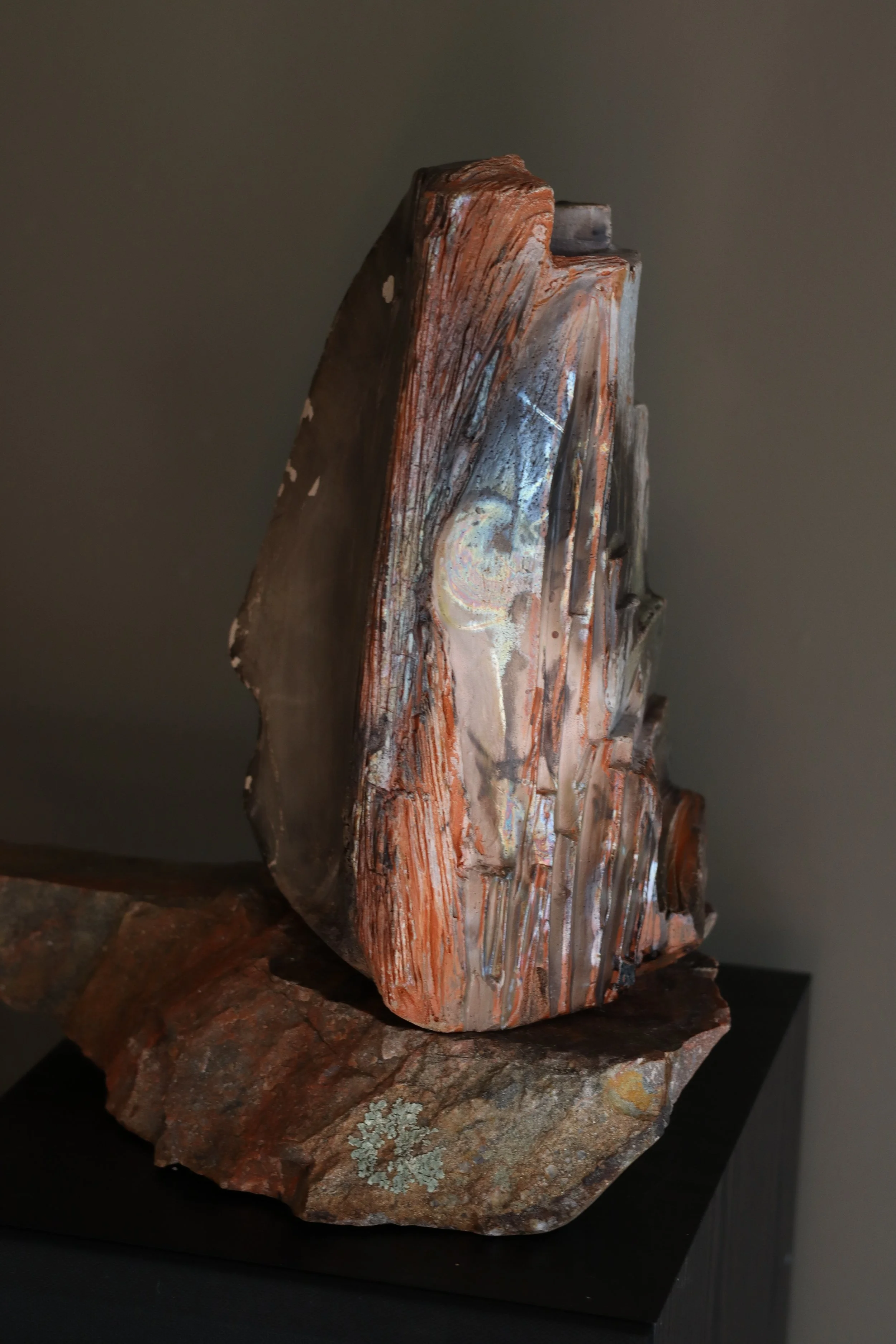
Smoke Fired Raku Clay using Wild Foraged Clay for Terra Sigillata, Kurinuki Technique
A Smoke Fired Series from the Study of Losses Exhibition
Fault Line
What is Left Behind
Below the Surface
Overburden - 7×11×5
Ledge
My work investigates material memory, environmental erosion, and our evolving relationship with the land. Fracture Lines consists of hand-carved vessels created through Kurinuki, a traditional Japanese technique of hollowing solid clay blocks. Each form began as 25–50 pounds of Raku clay, slowly excavated into being, echoing the landscapes and geologic shifts I reference.
The surfaces are layered with Terra Sigillatas made from foraged and local clays, embedding the mineral signatures of place. Copper, steel wool, and native plants were introduced during firing, producing chemical reactions that left unpredictable marks. A final 24-hour smoke firing completed the transformation, embracing chance and the alchemy of fire.
The series reflects on fractures—geologic, ecological, and human-made. It speaks to the visible and invisible disruptions we impose on ecosystems, particularly the fragile balance of water and stone within the Canadian Shield and Niagara Escarpment. These vessels serve as both artifact and witness, holding space for the fractures we can no longer ignore.
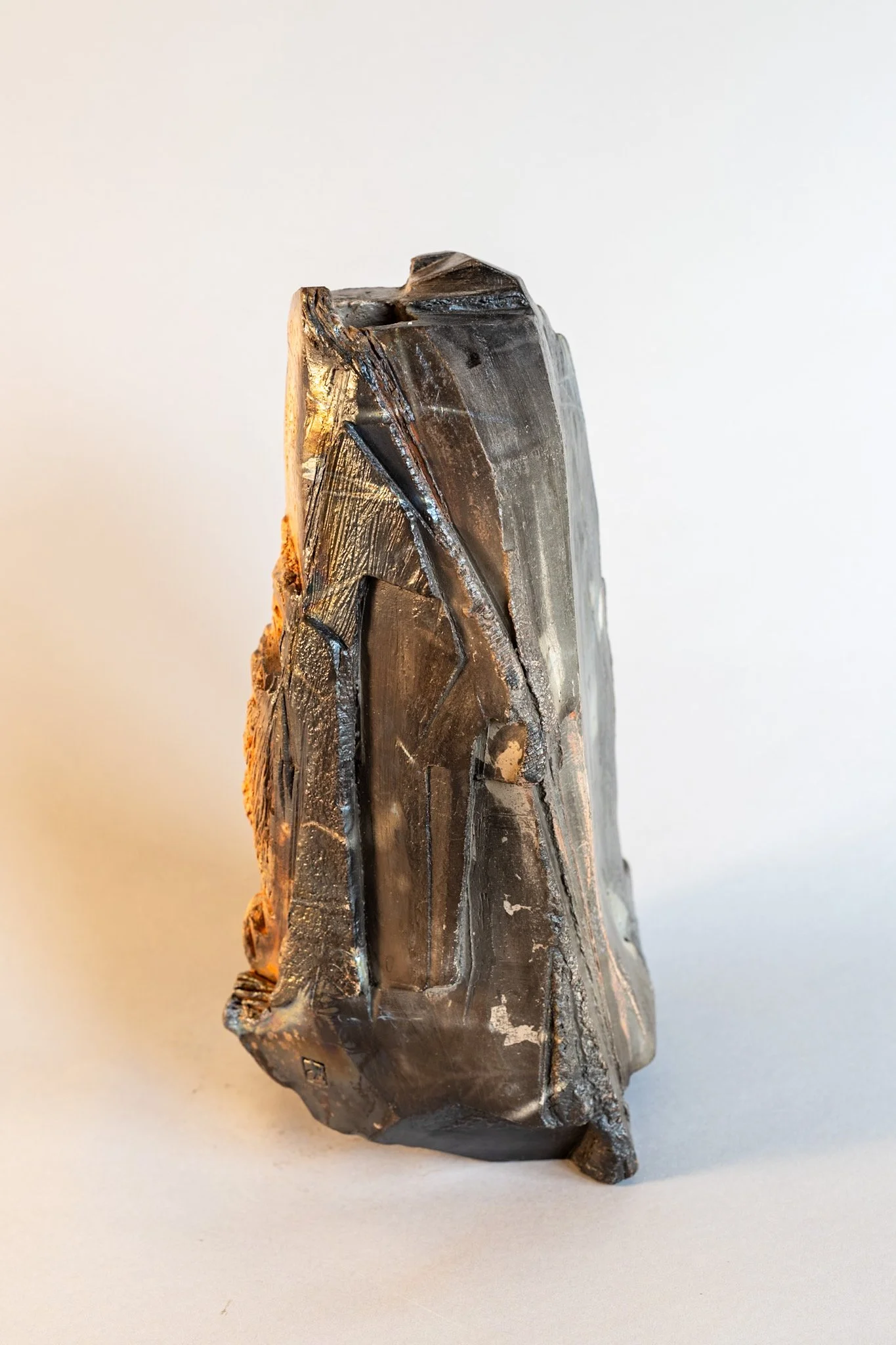
Smoke Fired Raku Clay using Wild Foraged Clay for Terra Sigillata, Kurinuki Technique
A Smoke Fired Series from the Study of Losses Exhibition
Fault Line
What is Left Behind
Below the Surface
Overburden
Ledge
My work investigates material memory, environmental erosion, and our evolving relationship with the land. Fracture Lines consists of hand-carved vessels created through Kurinuki, a traditional Japanese technique of hollowing solid clay blocks. Each form began as 25–50 pounds of Raku clay, slowly excavated into being, echoing the landscapes and geologic shifts I reference.
The surfaces are layered with Terra Sigillatas made from foraged and local clays, embedding the mineral signatures of place. Copper, steel wool, and native plants were introduced during firing, producing chemical reactions that left unpredictable marks. A final 24-hour smoke firing completed the transformation, embracing chance and the alchemy of fire.
The series reflects on fractures—geologic, ecological, and human-made. It speaks to the visible and invisible disruptions we impose on ecosystems, particularly the fragile balance of water and stone within the Canadian Shield and Niagara Escarpment. These vessels serve as both artifact and witness, holding space for the fractures we can no longer ignore.
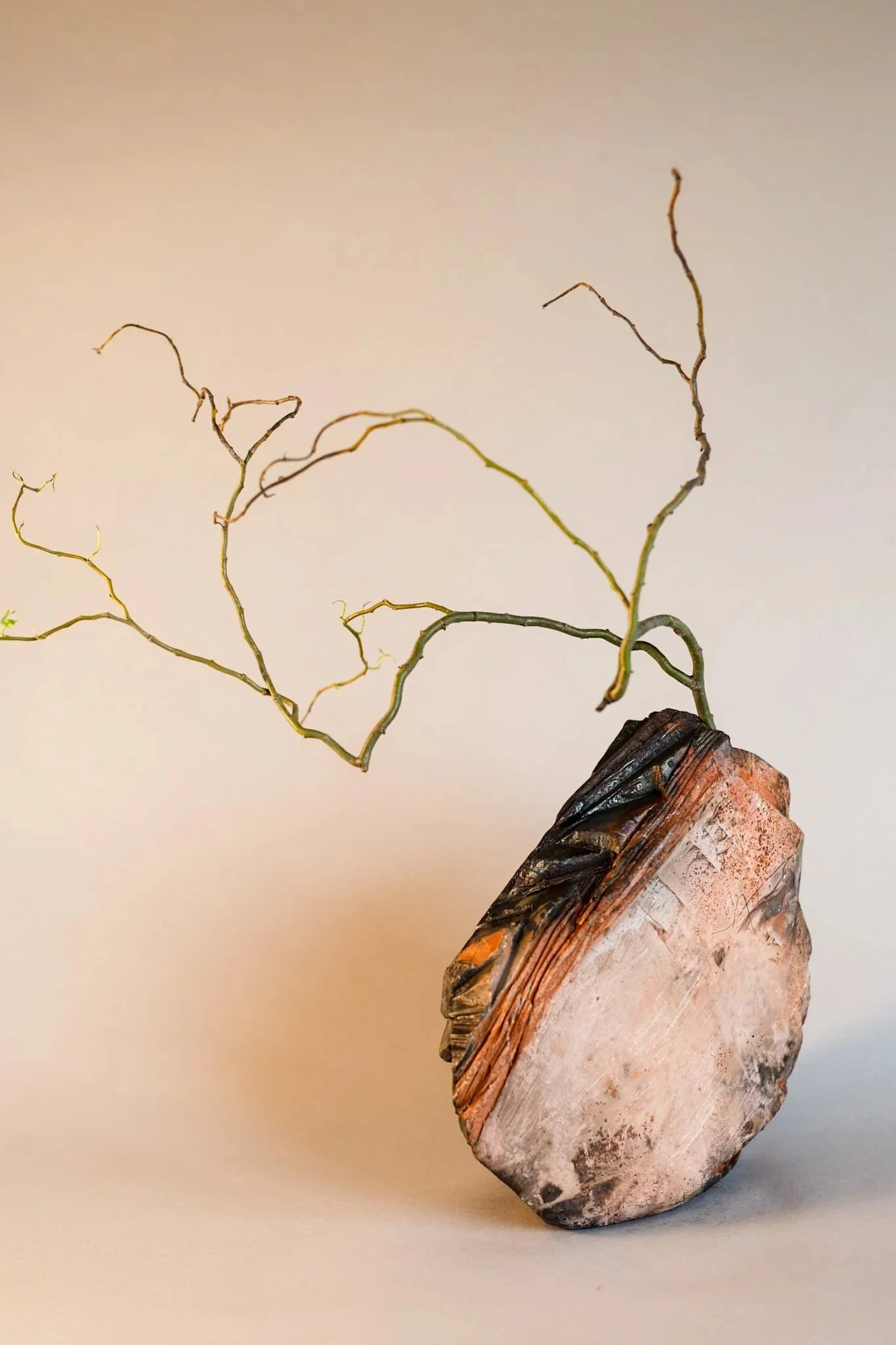
Smoke Fired Raku using Wild Foraged Clay for Terra Sigillata
Kurinuki Technique
My work is rooted in the rhythms and transformations of the natural world. For this exhibition, I explored the elemental force of fire—its power to both destroy and renew—through a sculptural piece that reflects on regeneration after forest fires, a growing presence across Canada.
This work also honours clay as a material deeply tied to the earth and human history. Formed over time through natural weathering, clay is essential to both soil health and centuries of craft.
Using a 25lb block of Raku clay, I employed Kurinuki, a traditional Japanese carving technique, to shape the form by hand, evoking geological erosion. Foraged wild clays from my land on the Niagara Escarpment were refined into Terra Sigillata for surface finishing, connecting the work to place. The final transformation occurred through a smoke firing process using invasive and native plant matter, metals, and salt—an alchemical finish that reveals the quiet beauty left by fire.
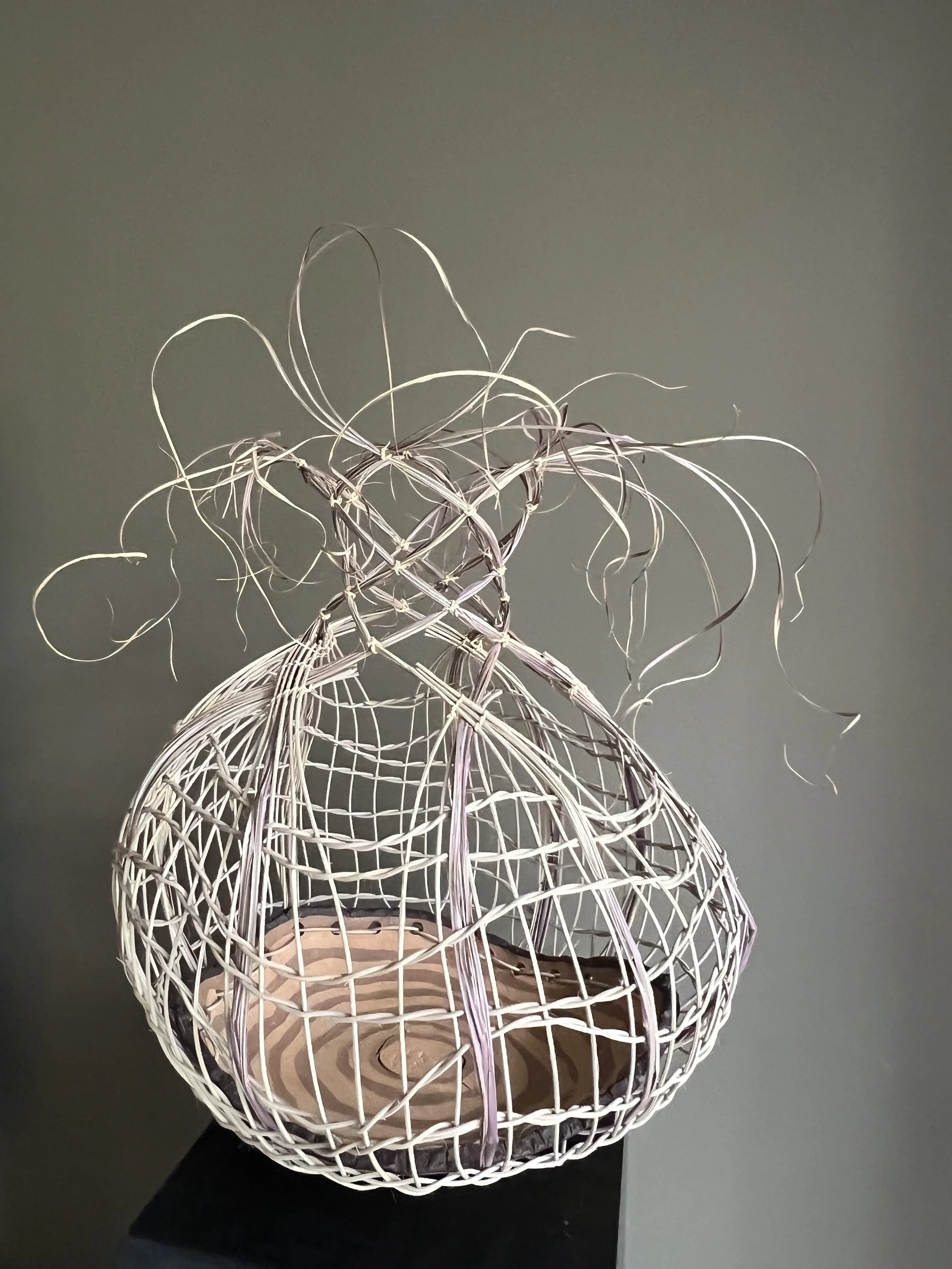
Naturally Dyed Reed with Black Tea, Dried curly grasses from my home and Paper string.
H20"xW17"
This work rises like a forest—five clusters of uprights, uneven at their base yet converging into a natural geometry at the crown. They defy the rules of traditional basketry, much like trees themselves defy order, bending and reaching toward light. In their asymmetry, a new harmony is born.
The making was a meditation, a puzzle without an answer, a form that revealed itself only through surrender. It carried me into the deep silence of old-growth forests, where even in death, trees nurture life. Their presence endures in every stage: seed and seedling, sapling, towering trunk, standing ghost, fallen elder. Each phase offers shelter, nourishment, renewal.
The purple hues recall the hills of Creemore on the Niagara Escarpment, grounding the work in place while speaking to the cycles of growth and decay. This piece is a reminder that in the forest—as in life—every ending feeds a beginning, and all flourishing is mutual.
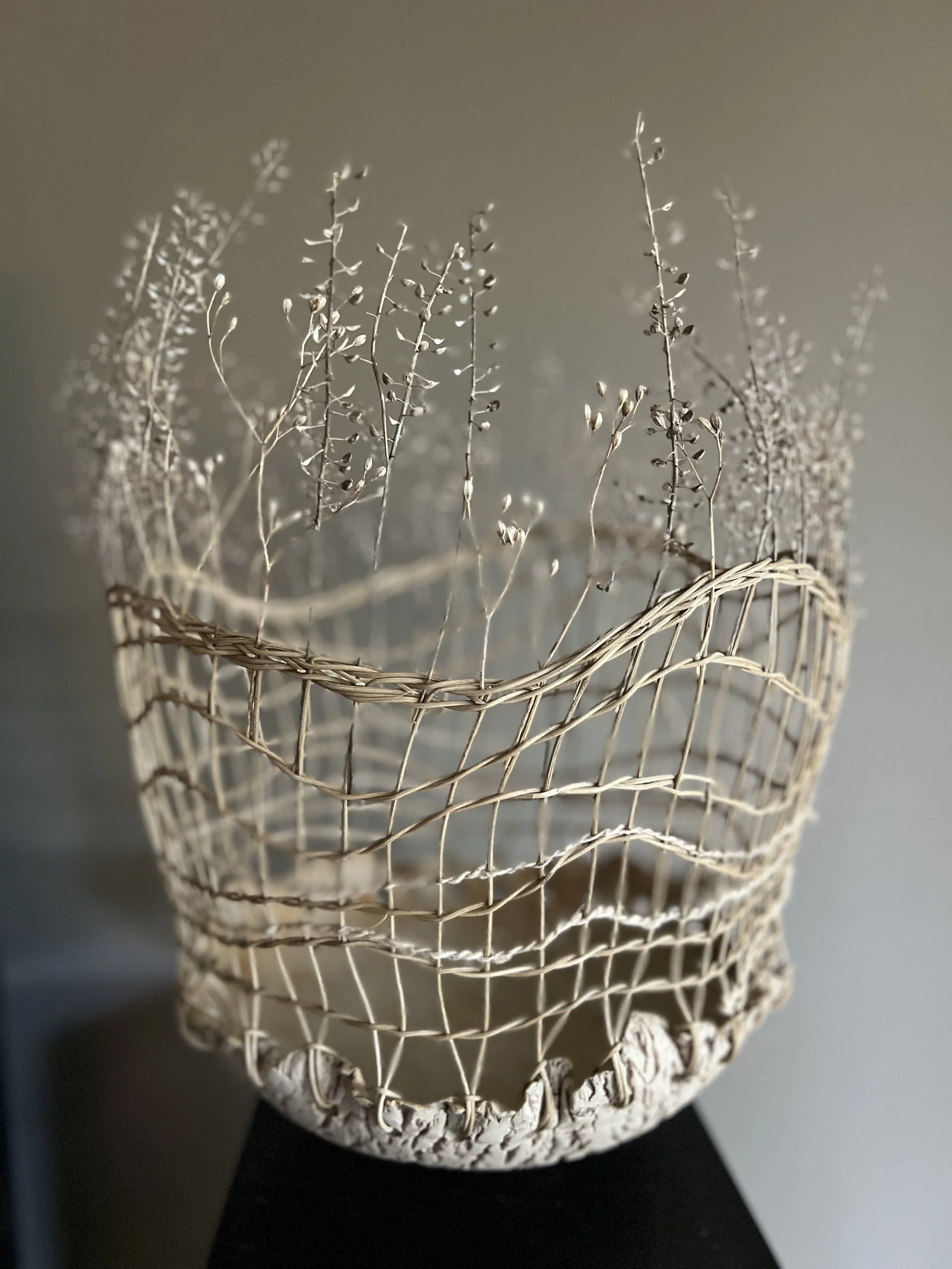
Carved Stoneware Clay base, Reed and Wild Grass weaving with Hand-spun Nettle Cordage.
17”x19”
“Dancing over the earth,
Seeds whispered to us all,
Just listen closely”.
~unknown
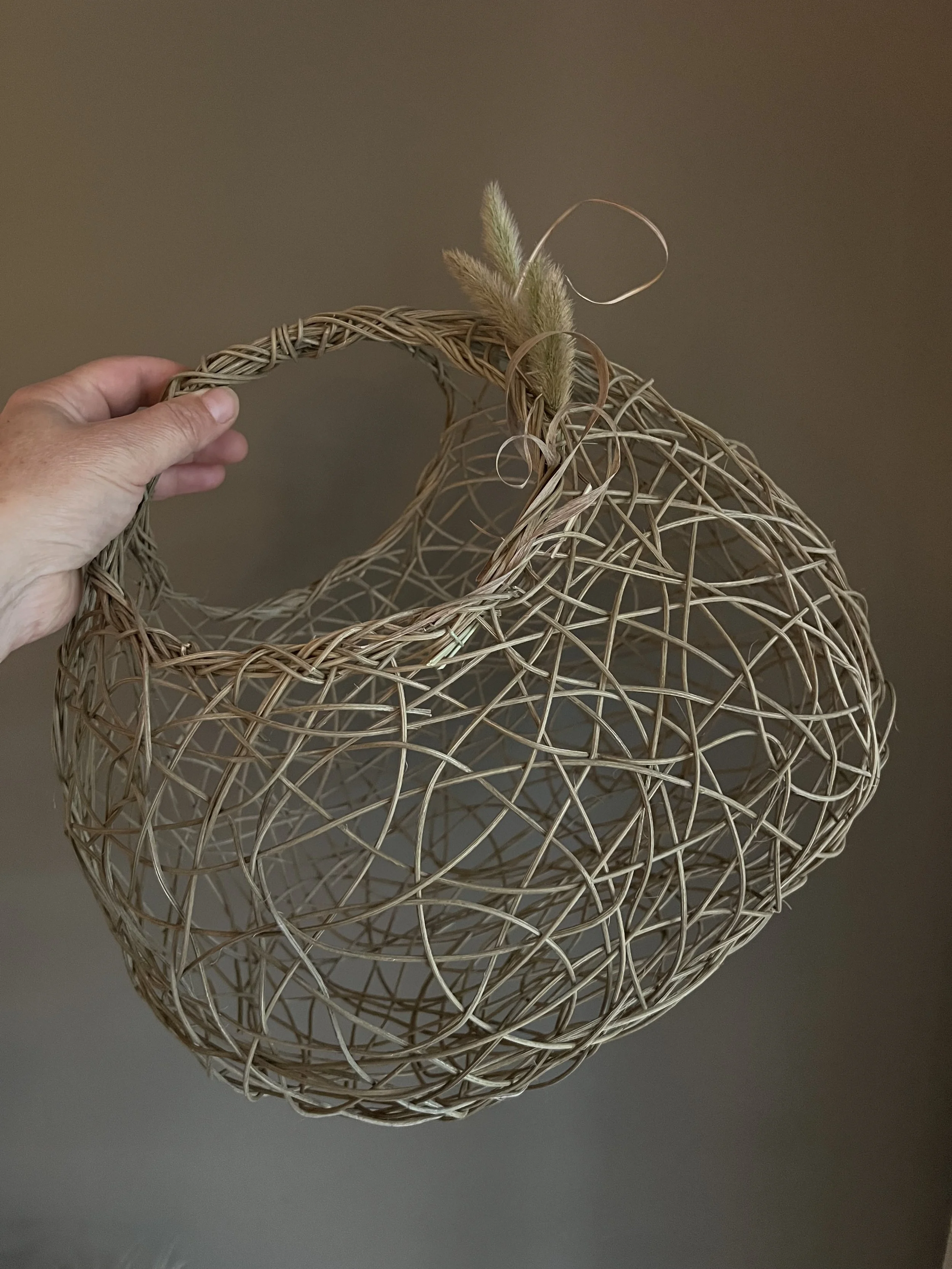
Smoked Reed random weave embellished with wild grasses from my homestead.
15”x13”x11”
A nod to the traditional and the random. The functional and the sculptural. The essence of what a vessel holds and a look into vessels as memory keepers.
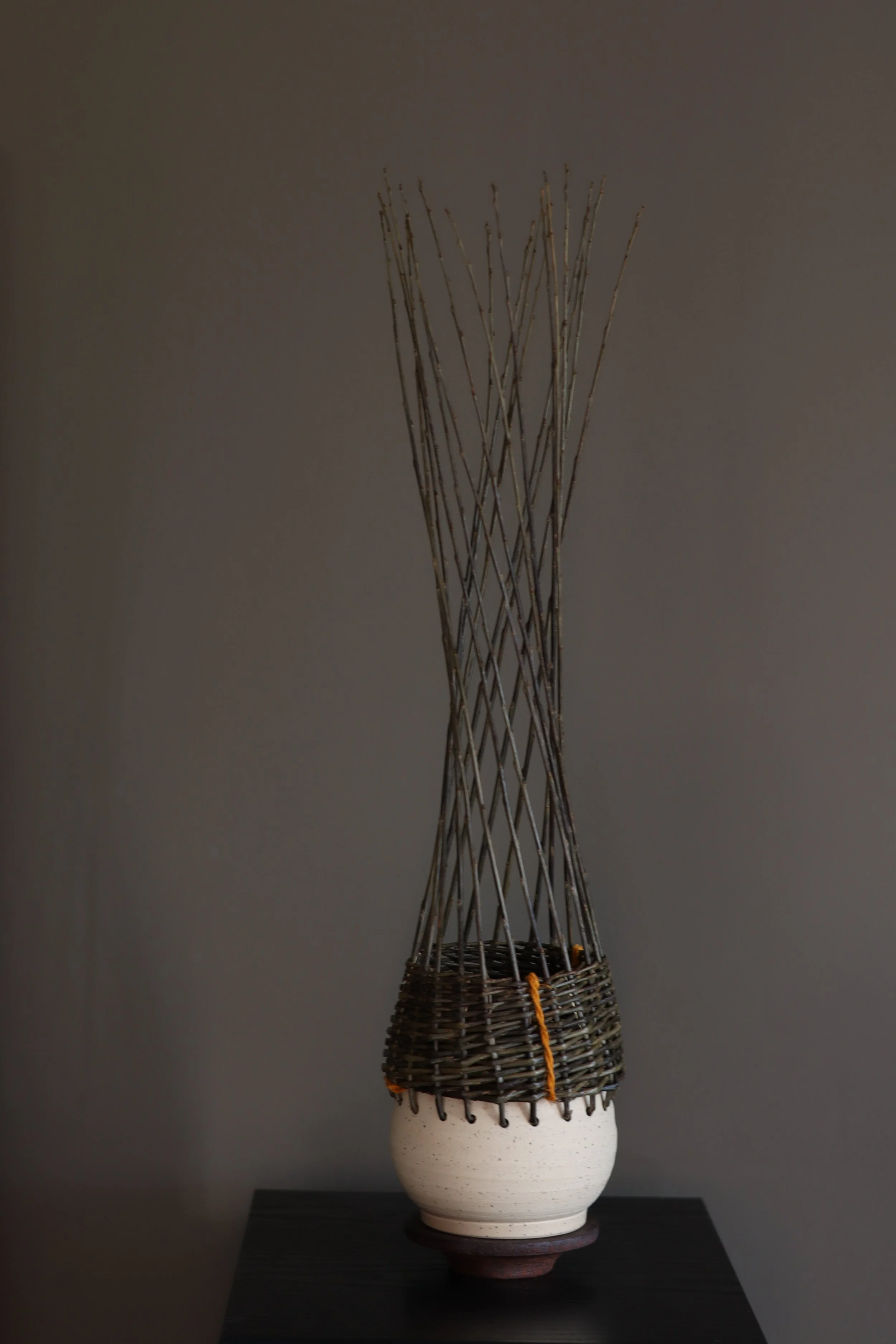
Wheel Thrown Stoneware, Glaze, Foraged Willow, Naturally Dyed Hemp Cord
20" x 6"
$1100
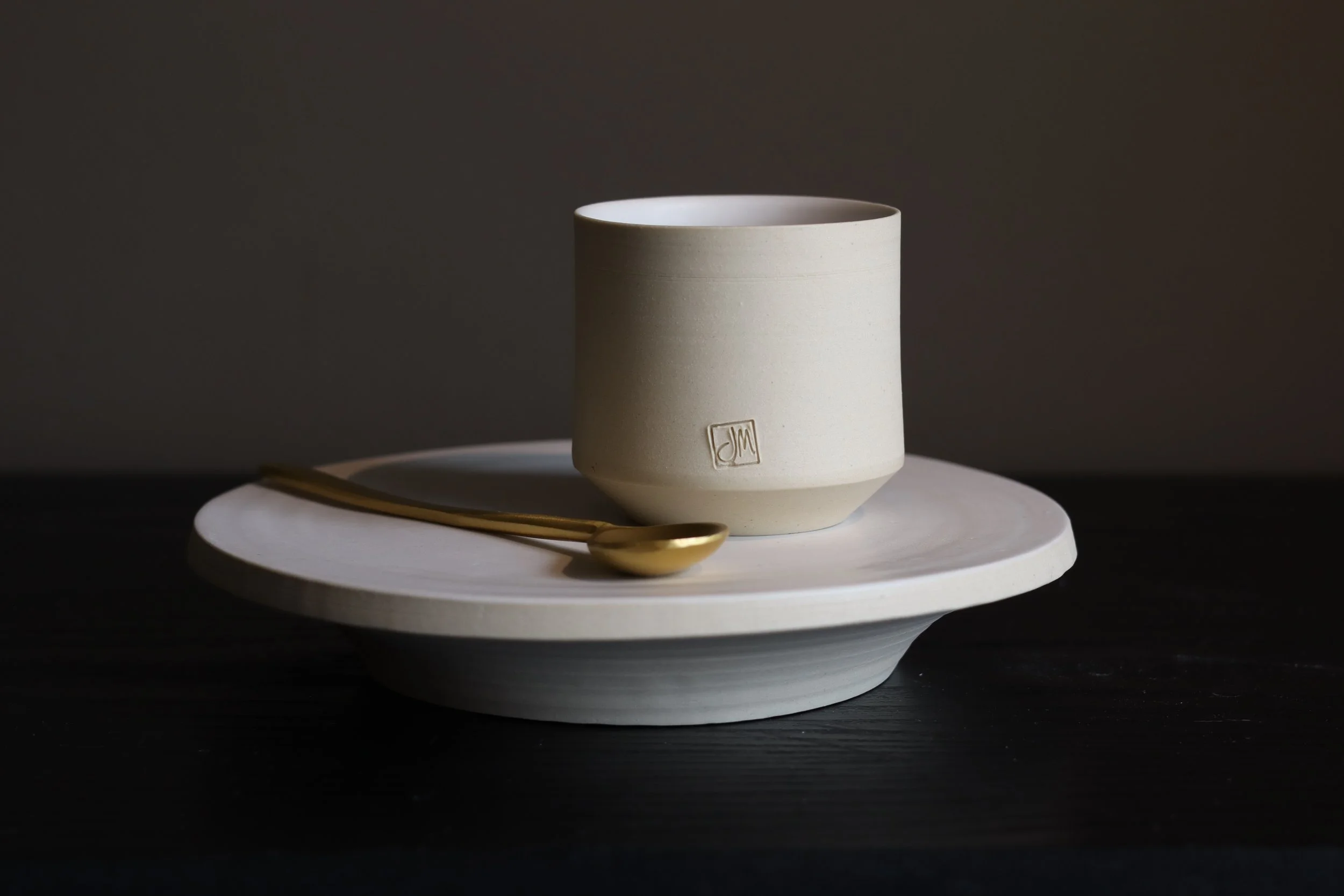
Minimalist aesthetic with angled and polished bottoms. Exposed Buff White Stoneware exteriors. Delightful to hold for hot or cold beverages. Holds approx ~3ozs.
~6cm x 6cm
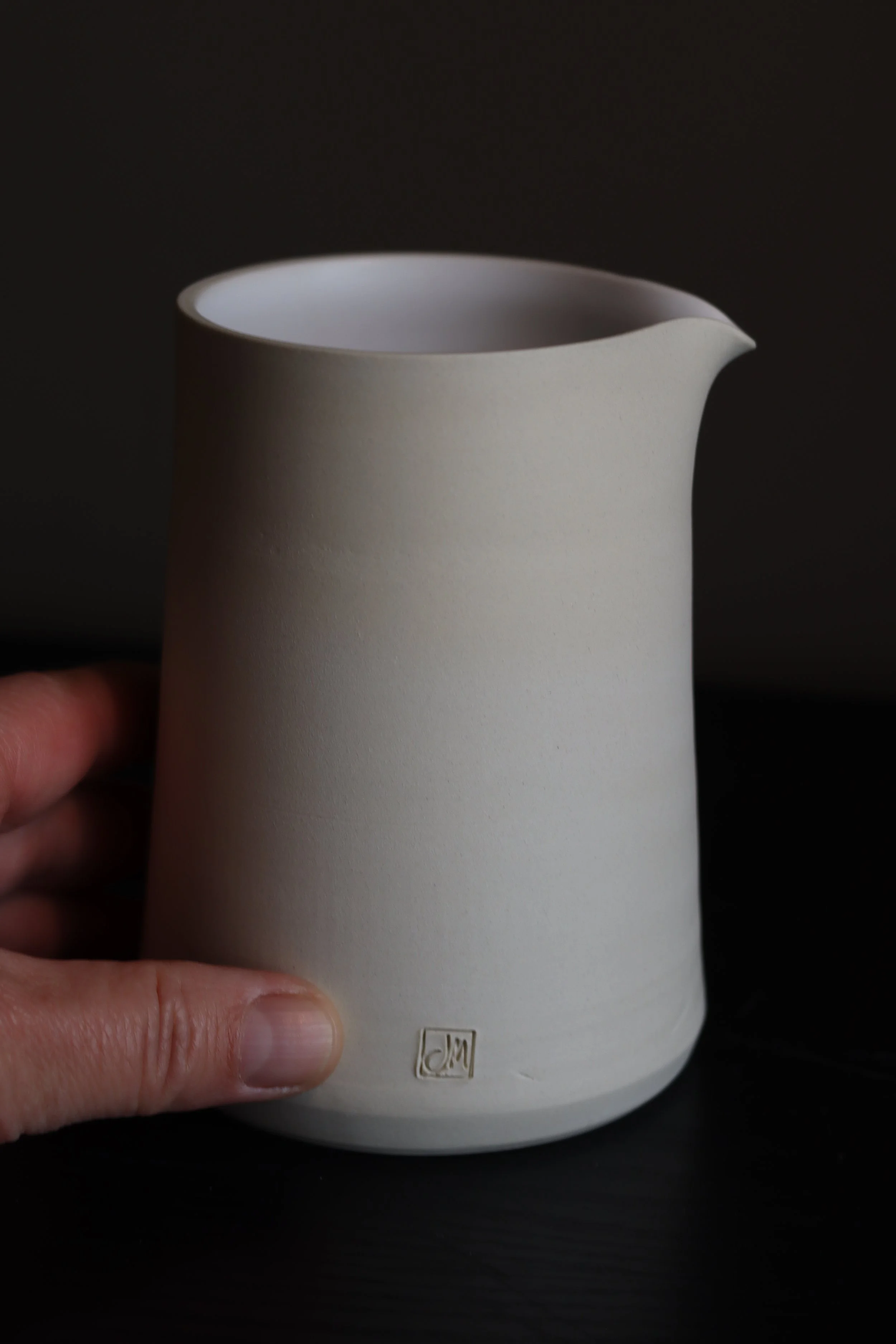
Modern lines with a minimalist appeal. Exposed Buff Stoneware exteriors and white interiors.
Three sizes to choose from:
Small (Creamer)- 9cm x 7cm
Medium (Milk Jug, Vase)- 9cm x 12cm
Large (Water Jug, Decanted Wine, Flower Vase)- 10cm x 15cm
As with all handmade items, variation in size, shape and colouration is inevitable and part of the inherent charm of the product.
Dishwasher, Microwave and Oven safe.
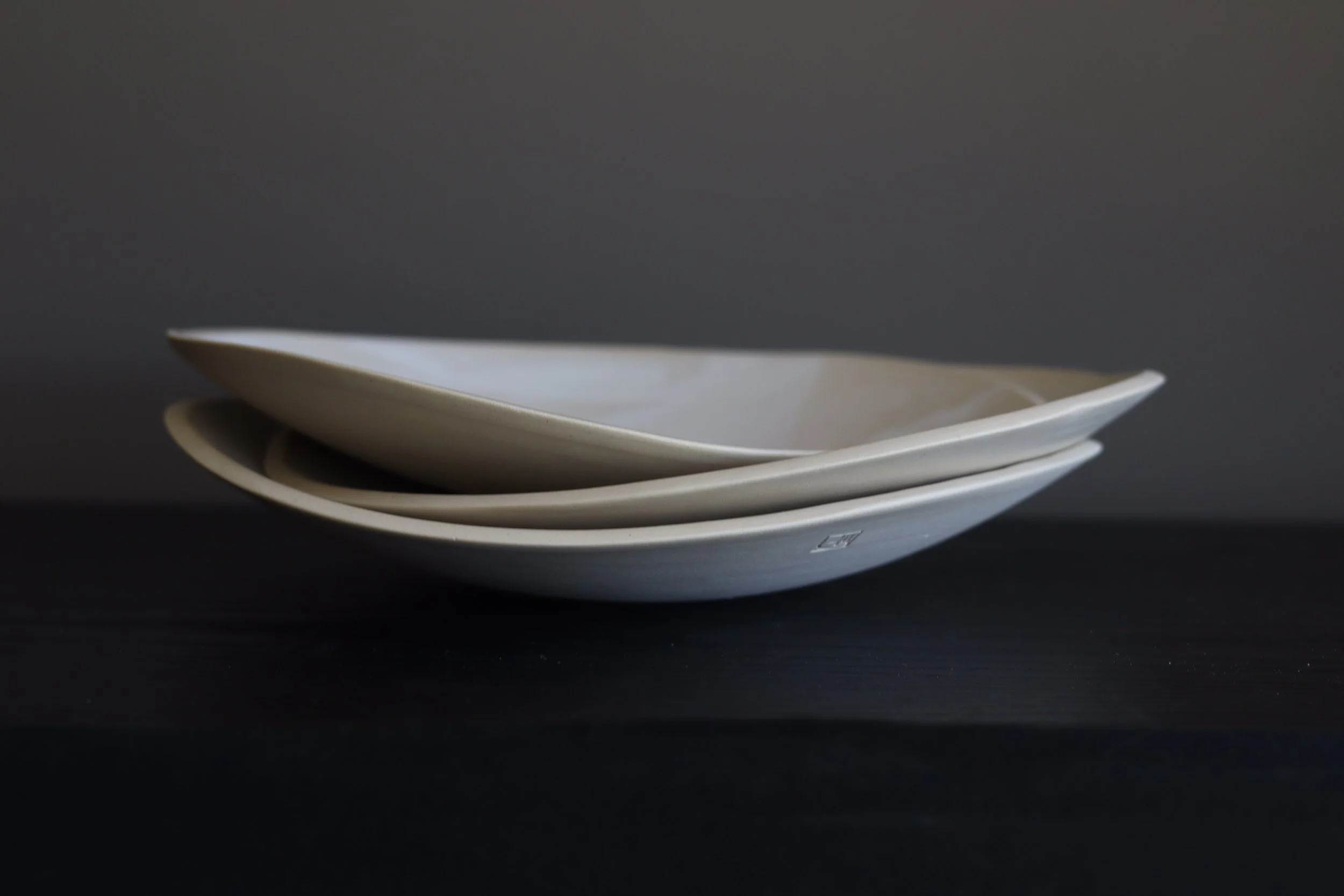
Made with Buff Stoneware Clay and a hand poured matte white mineral glaze. These organically edged vessels are both stunningly beautiful and fully functional as vessels for food.
Bowls- 21 cm x 3 cm
Wabi-sabi is a Japanese aesthetic that embraces the beauty of imperfection and natural simplicity.
Wabi:
This part of the term refers to a sense of simplicity, modesty, and natural beauty. It can also be understood as a kind of "less is more" philosophy.
Sabi:
This refers to the beauty that comes with age and the passage of time, like the patina on a piece of furniture or the character in a worn-out object.
As with all handmade items, variation in size, shape and colouration is inevitable and part of the inherent charm of the product.
Dishwasher, Microwave and Oven safe.
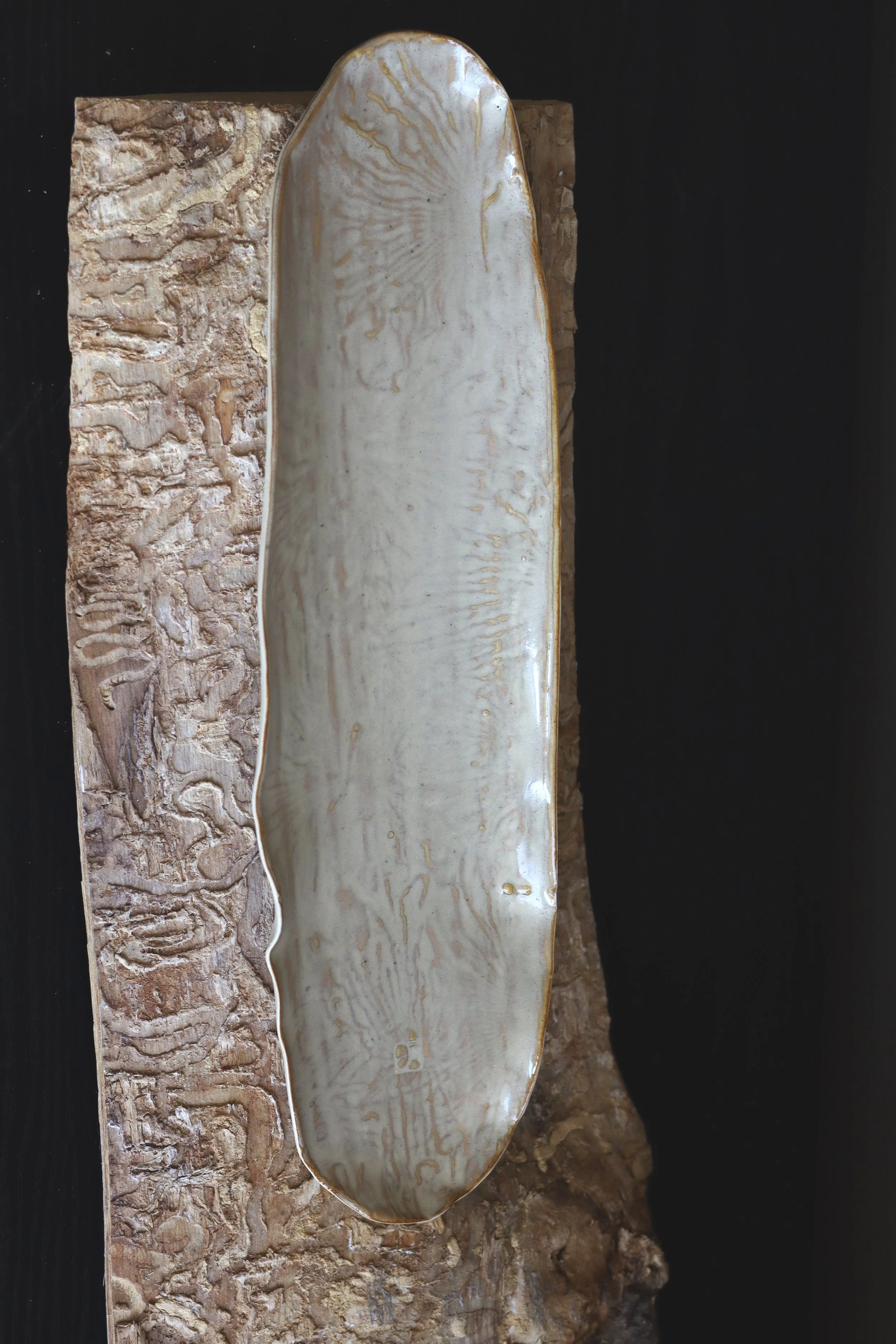
Buff Stoneware with Ash Glaze.
Food safe.
Created as an homage to the fallen ash trees on our property, caused by the emerald ash borer. The larvae, often referred to as "woodworm," bore into the wood, creating tunnels and consuming the wood as they develop. What is left behind is devastating, but also stunningly beautiful. This is what I wanted to capture in these very special pieces.
A nod to the Japanese Art of Impermanence: “An acceptance that there is beauty in imperfection, impermanence, and simplicity. It embraces the natural decay and aging of objects, seeing them as more beautiful and unique due to their history. It's a philosophy that encourages acceptance of flaws and a focus on the present moment”.
Extra Long Oval Platter 1- (52cm x 10 cm)
Long Oval Platter 2- (52cm × 8cm)
Medium Platter Oval- (41cm x 11cm)
Medium Platter Rectangular- (41cm x 11cm)
Small Oval Platter- (31 cm x 9cm)
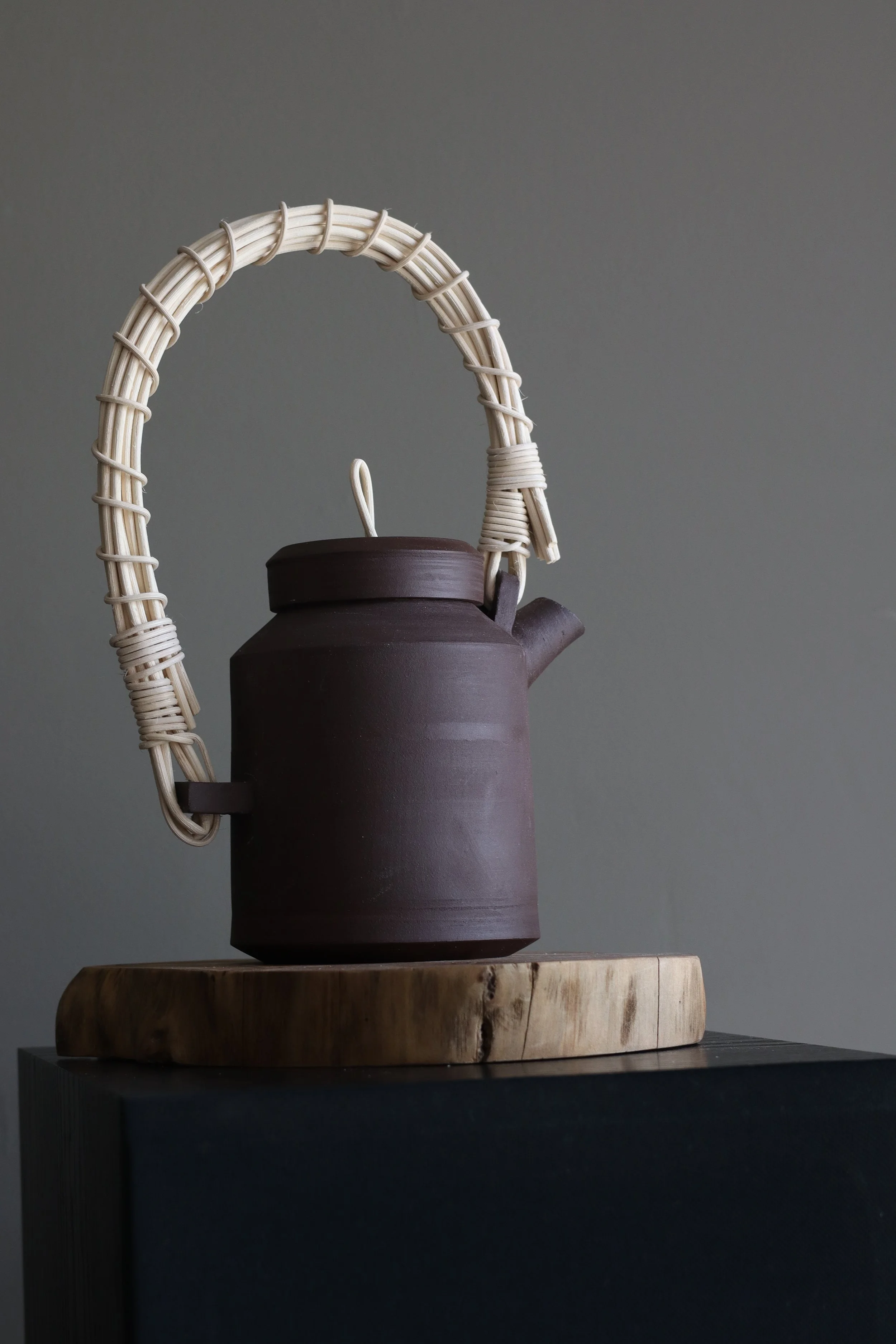
Made from luscious dark brown stoneware clay with personally handwoven cane and bamboo handles. These functional pieces are also works of art and make for stunning display pieces. Don’t hide them away in your cupboard.
One of a kind.
*Each teapot is a labour of love, taking over 2 months to complete. Each vessel is made from up to 7 different wheel thrown and hand formed pieces of clay, combined to create the final beauty of this seamless and minimalist piece. The handles are handwoven personally from strands of reed and cane directly onto the piece, made to accentuate the shape and functionality of the vessel.
Vessel (without handle)- H15cm x Diameter 12cm
Largest Total Dimensions including Spout and Handle- H29cm x W18cm
Hand wash Only.
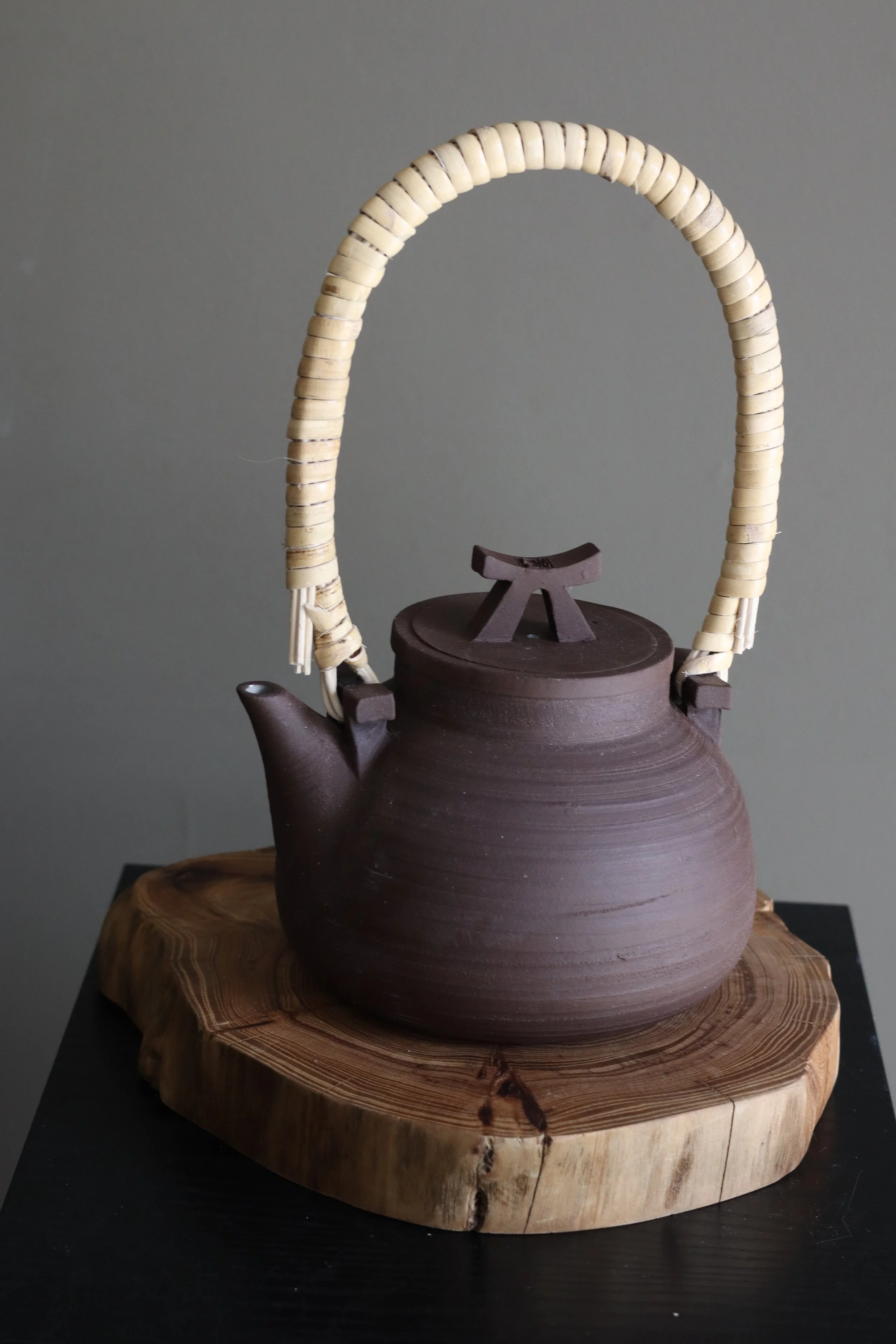
Made from luscious dark brown stoneware clay with personally handwoven cane and bamboo handles. These functional pieces are also works of art and make for stunning display pieces. Don’t hide them away in your cupboard.
One of a kind.
*Each teapot is a labour of love, taking over 2 months to complete. Each vessel is made from up to 7 different wheel thrown and hand formed pieces of clay, combined to create the final beauty of this seamless and minimalist piece. The handles are handwoven personally from strands of reed and cane directly onto the piece, made to accentuate the shape and functionality of the vessel.
Vessel (without handle)- H13cm x Diameter 15cm
Largest Total Dimensions including Spout and Handle- H26cm x W16cm
Hand wash Only.
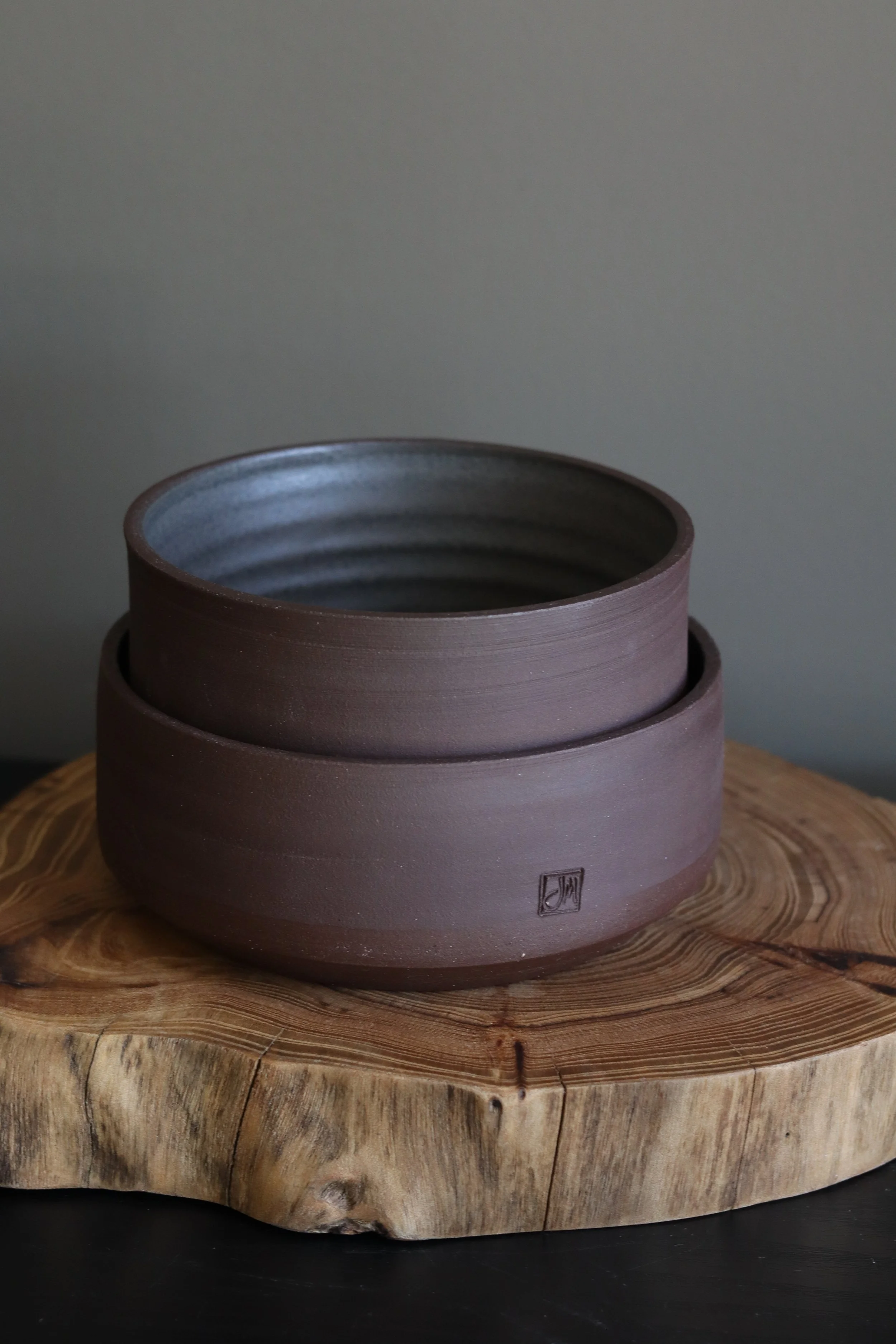
Straight sided bowls with an angular profile in dark brown clay and charcoal shino glazed interiors.
Sold separately.
Bowl 1- 13cm x 5.5cm
Bowl 2- 12cm x 7cm
As with all handmade items, variation in size, shape and colouration is inevitable and part of the inherent charm of the product.
Dishwasher, Microwave and Oven safe.

A longstanding piece in the JM collection and a fan favourite for good reason.
The perfect form to enjoy a glass of wine or your favourite beverage. Well balanced and perfectly shaped, this makes the cup perfect for indoors or out. Exposed exterior is smooth with a polished pebble-like at the base and subtle ridges in the middle to make it easy to hold securely.
Excellent for hot or cold drinks.
Buff White Stoneware exterior paired with a wide variety of boldly glazed interiors.
Holds ~14+ ozs
~10cm x 9cm
As with all handmade items, variation in size, shape and colouration is inevitable and part of the inherent charm of the product.
Dishwasher, Microwave and Oven safe.
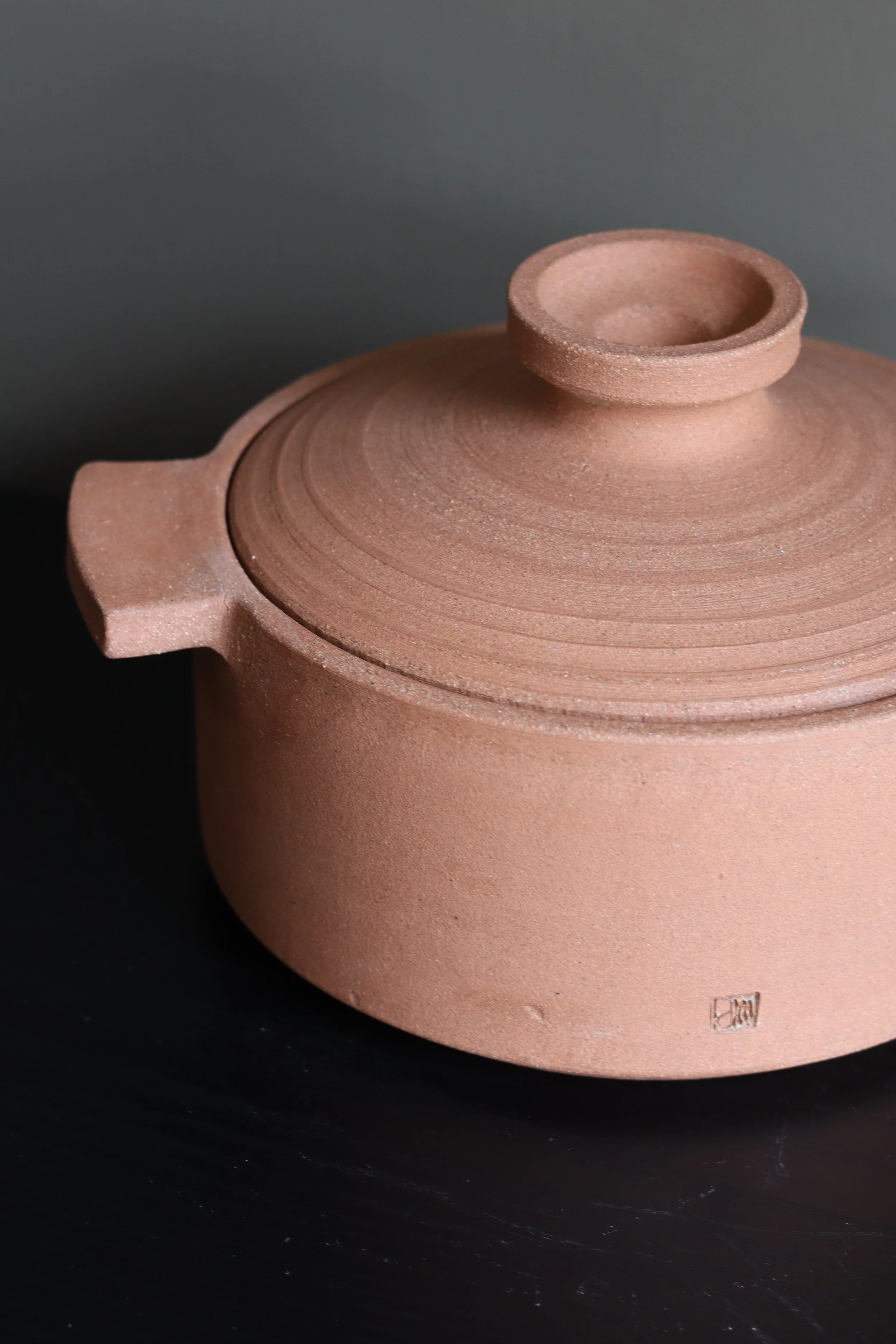
Minimalist and earthy variations on the traditional casserole dish in stunning Dark Red Stoneware. Designed and made to be used as functional dishes from oven to table.
The perfect piece for the cook or chef in your life.
Every little feature has been thoroughly thought through and meticulously crafted:
-weighted bottoms to retain and distribute heat evenly
-durably glazed interiors will stay scratch proof and easy to clean
-drip lines allow juices to drip back into the vessel after steaming up to the lid = acting like a traditional ‘Tagine’.
-steam vent in lid
Casserole 1- 20cm wide x 15cm tall with lid (Holds ~8 cups)
Casserole 2- 21cm x 12cm (Holds ~10 cups)
As with all handmade items, variation in size, shape and colouration is inevitable and part of the inherent charm of the product.
Dishwasher, Microwave and Oven safe.
* Always add food and then add the vessel to a cold oven before heating. Thermal shock may damage ANY clay vessel. Not recommended for freezer use when filled.
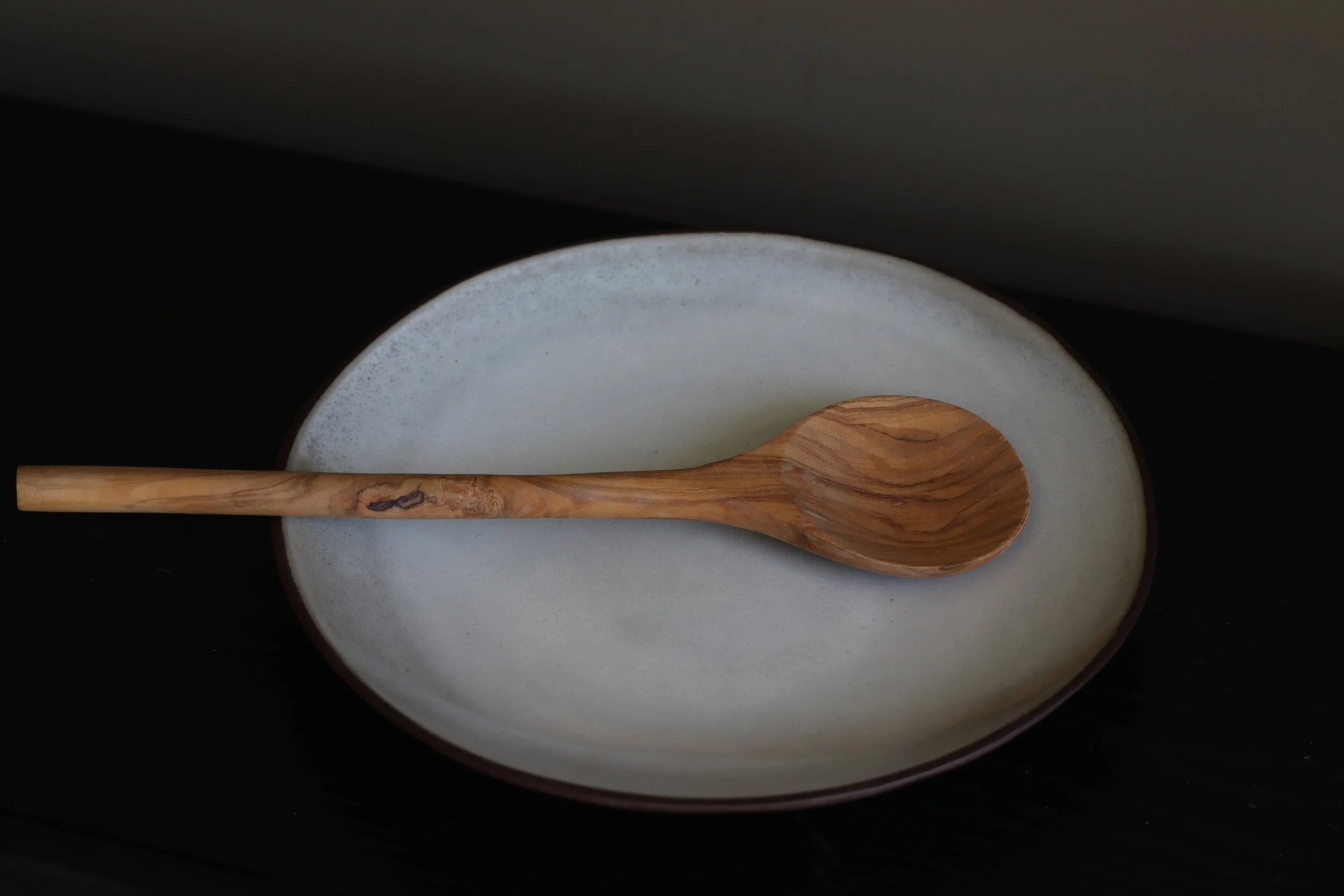
Made from luscious dark brown stoneware clay with a poured milk white glazed interior. The perfect fruit bowl or centrepiece. Excellent for serving. Pairs with anything in the dark brown clay.
27cm x 3cm
As with all handmade items, variation in size, shape and colouration is inevitable and part of the inherent charm of the product.
Dishwasher, Microwave and Oven safe.
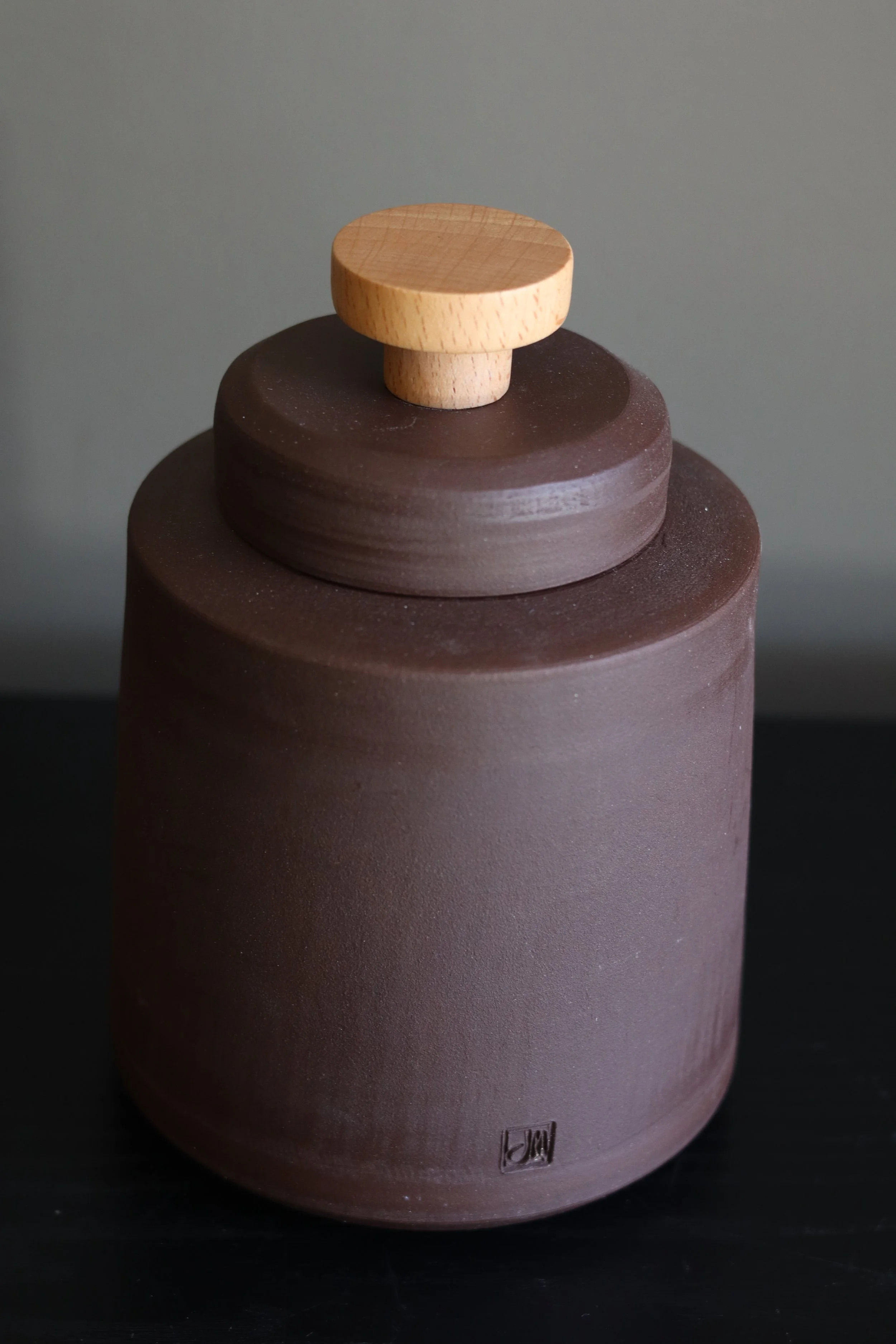
A stunning lidded jar made to display with pride. Dark brown stoneware clay with a subtle white interior. Perfect for storing tea, coffee, dog treats…anything. Turned Birch Knob is removable if required.
Pairs perfectly with the Dark Brown Teapot or Contemporary Coffee Mugs and Creamer.
Stands 17cm tall x 12 cm wide
As with all handmade items, variation in size, shape and colouration is inevitable and part of the inherent charm of the product.
Dishwasher, Microwave and Oven safe.
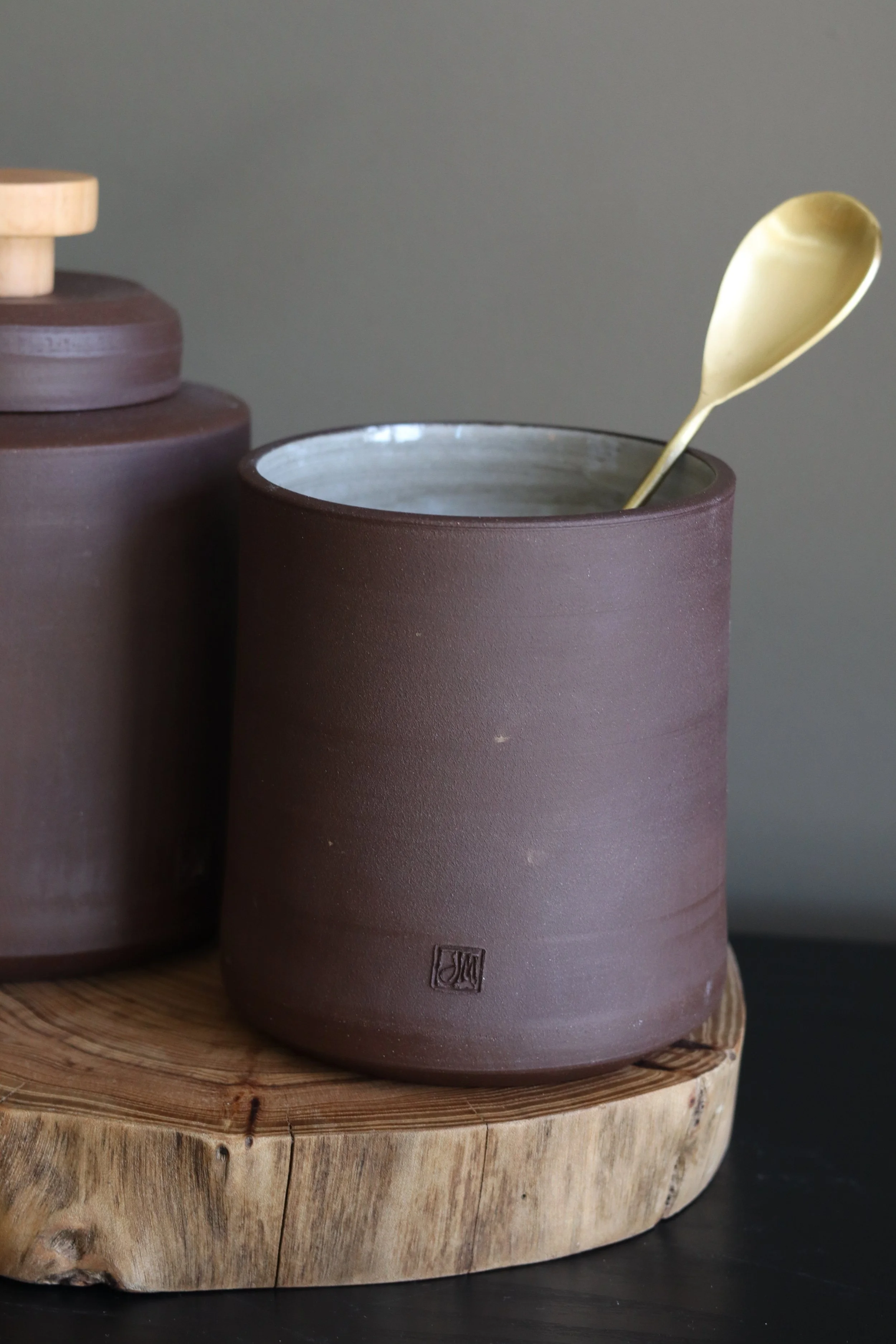
Made from luscious brown clay with a milky white glazed interior, this cylindrical vessel is perfect for storage. From pens and scissors to kitchen utensils, you’ll have endless possibilities.
11cm x 12cm
As with all handmade items, variation in size, shape and colouration is inevitable and part of the inherent charm of the product.
Dishwasher, Microwave and Oven safe.
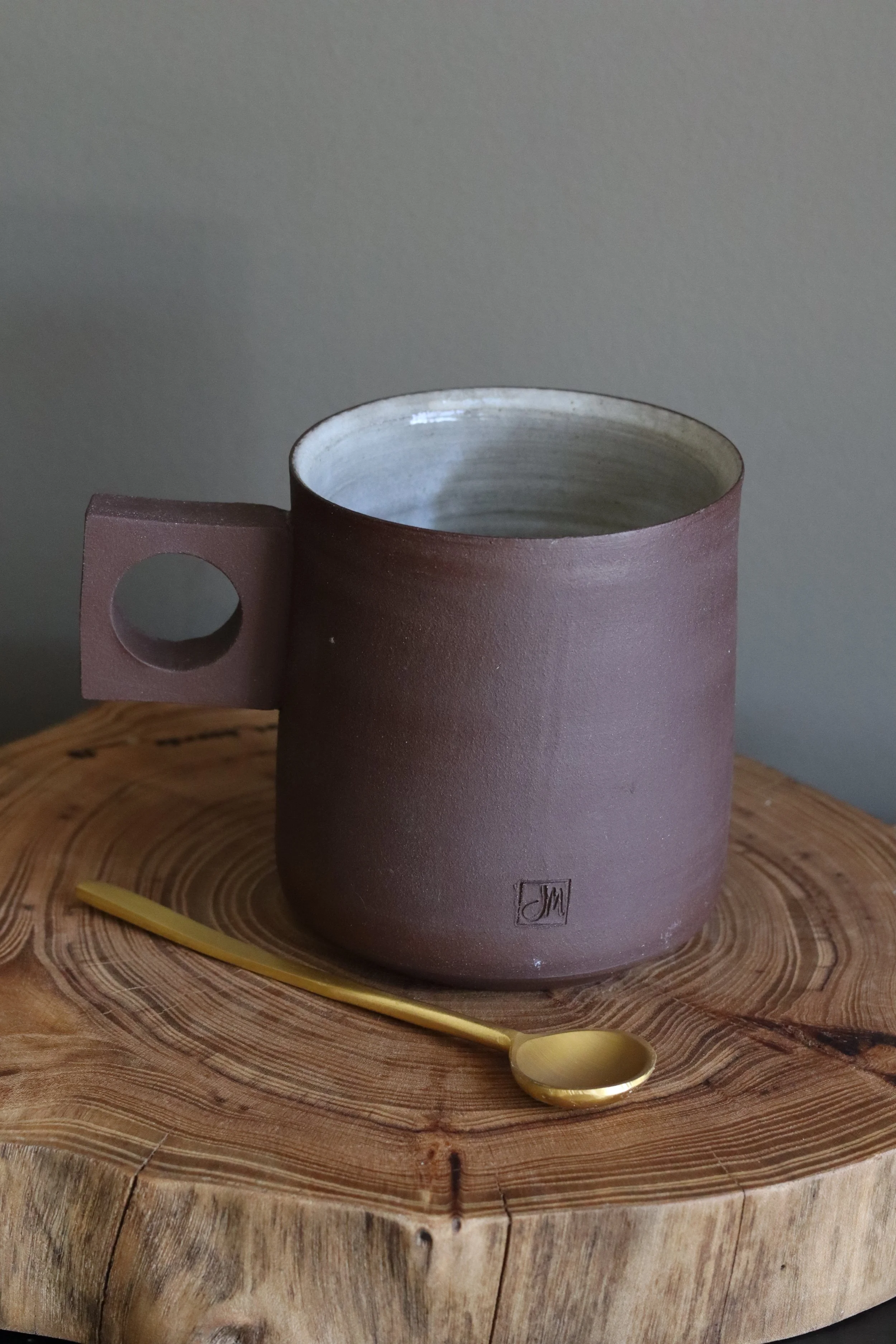
Made from luscious dark brown clay with exposed stoneware exteriors and muted white interiors. Polished bottoms. Perfectly weighted and delightful to hold.
Approx. 9cm x 8 cm
~10 ozs
*As with all handmade items, variation in size, shape and colouration is inevitable and part of the inherent charm of the product.
Dishwasher, Microwave and Oven safe.
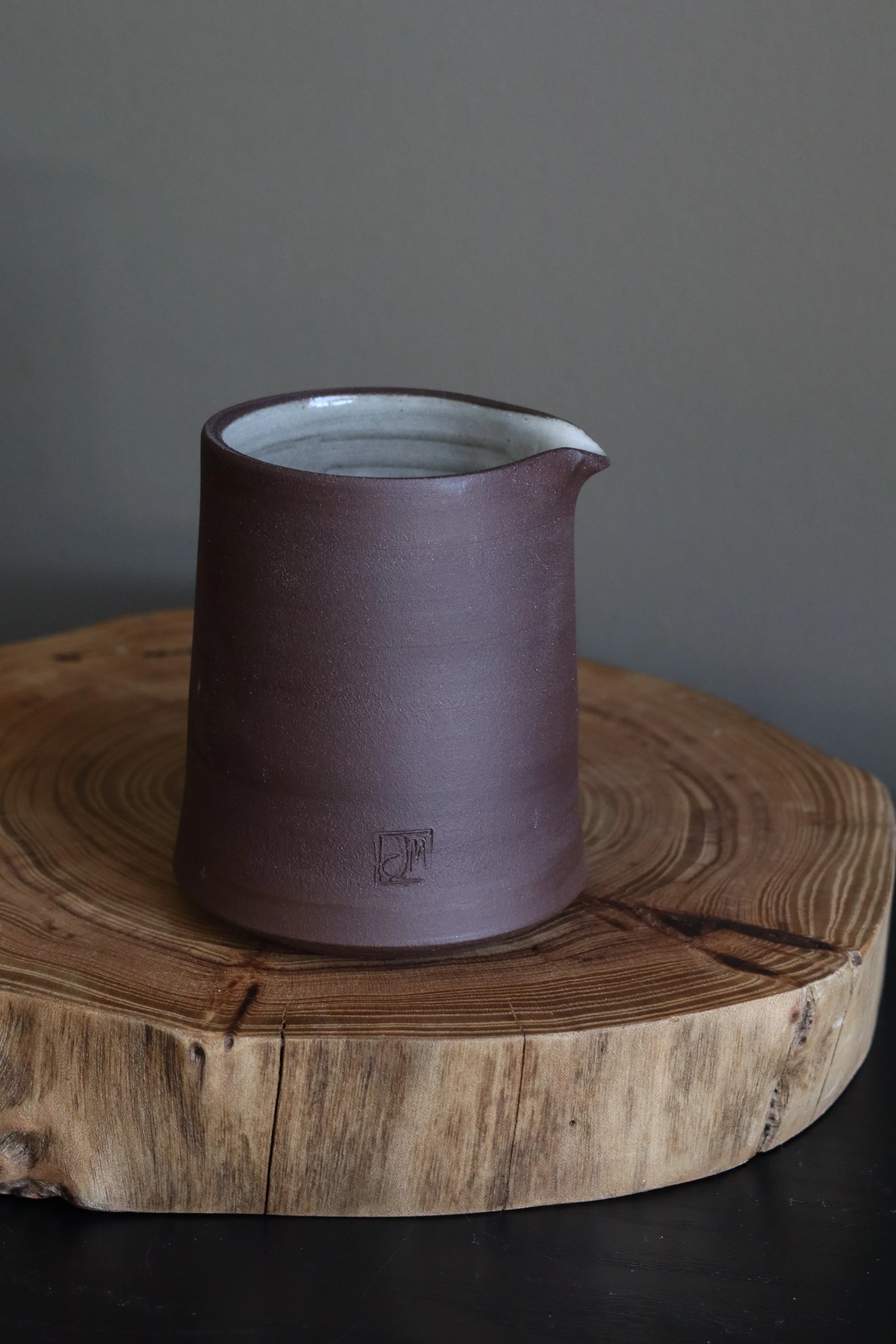
Wheel thrown in dark brown exposed clay exteriors and a white interior.
Pairs perfectly with anything in the dark brown clay.
7cm x 8cm
As with all handmade items, variation in size, shape and colouration is inevitable and part of the inherent charm of the product.
Dishwasher, Microwave and Oven safe.
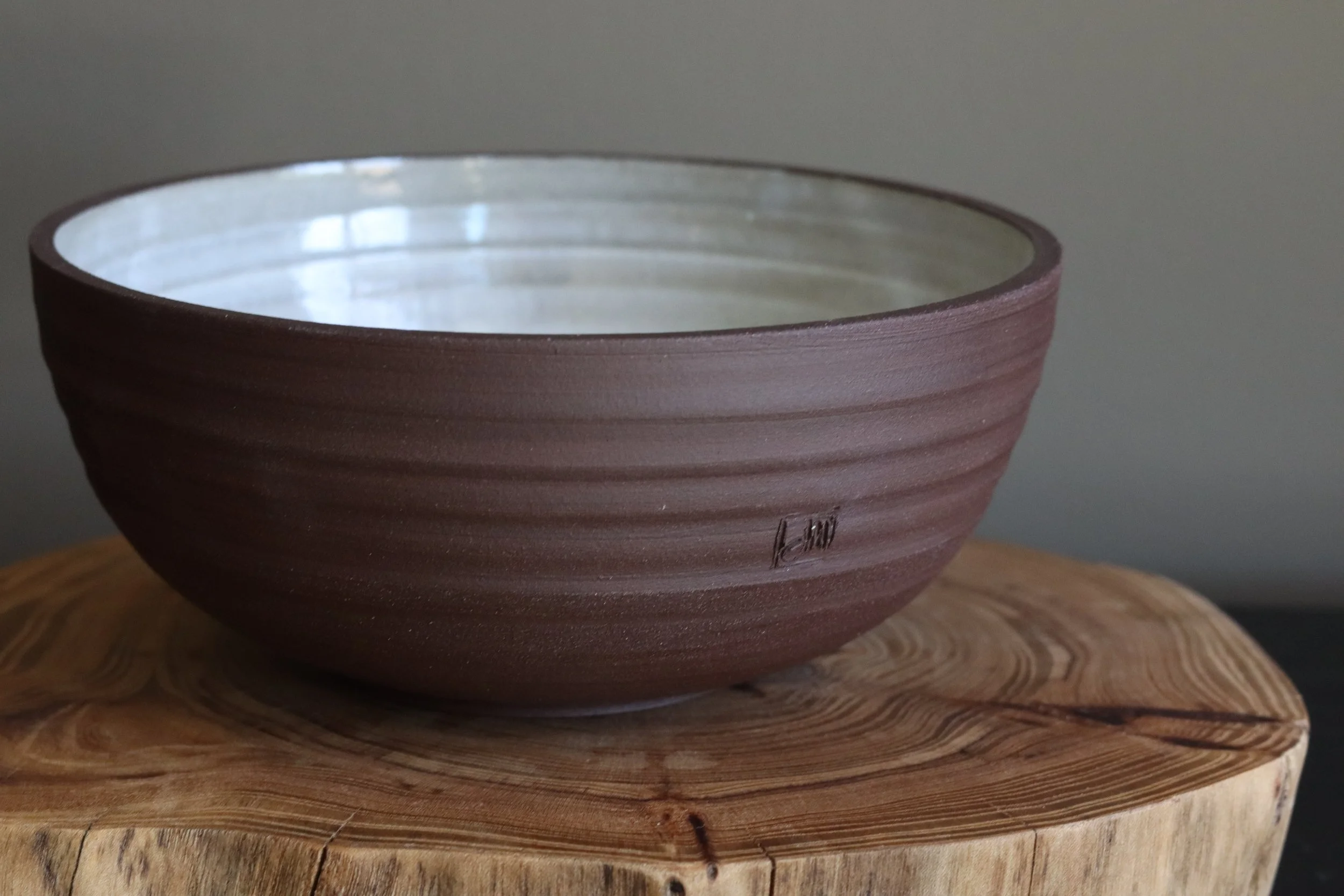
Wheel thrown bowl made from luscious dark brown clay. Exposed stoneware exterior and milky white interior. Perfect for almost anything you want to serve in a bowl for one or for sharing.
~16cm x 7cm
As with all handmade items, variation in size, shape and colouration is inevitable and part of the inherent charm of the product.
Dishwasher, Microwave and Oven safe.
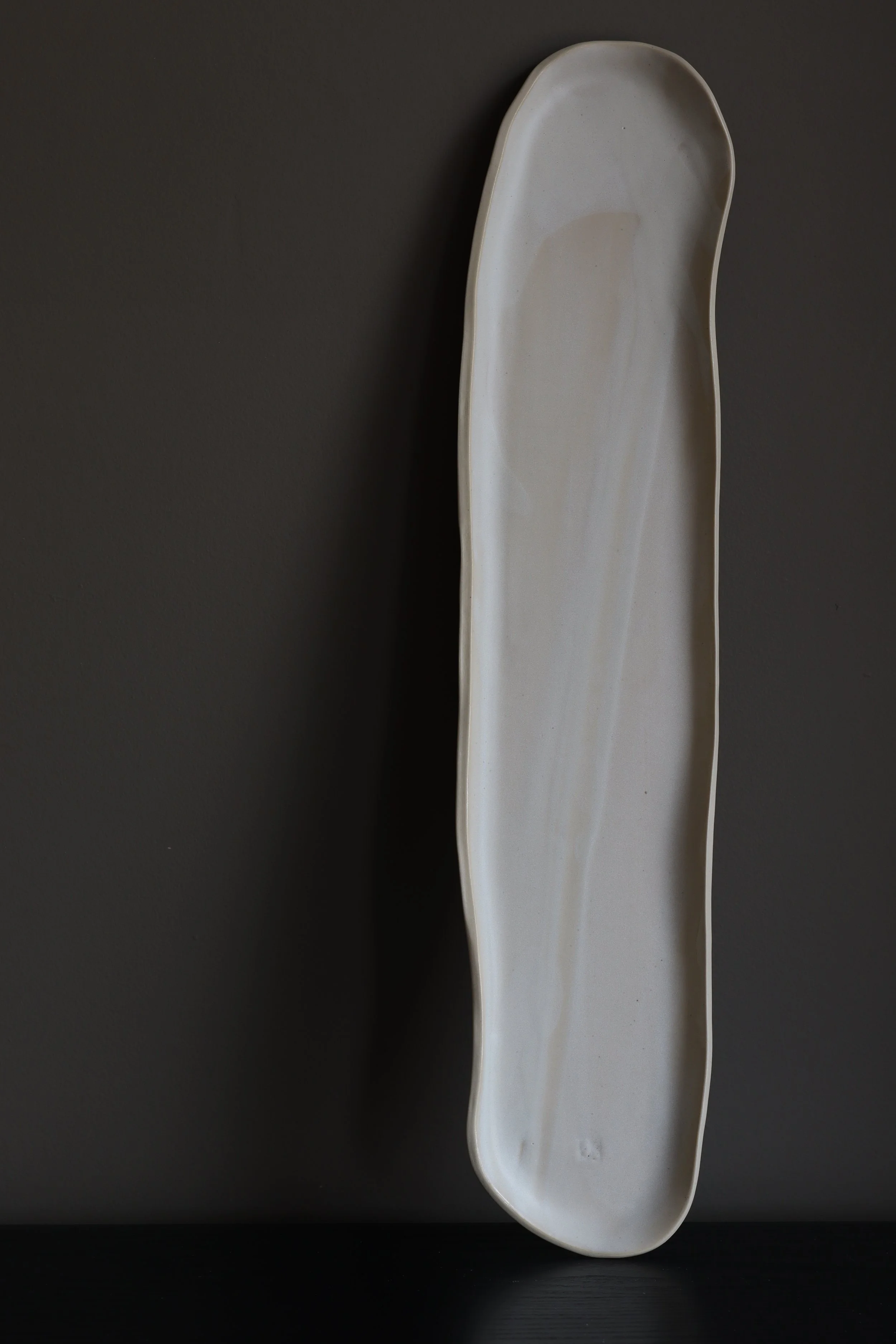
Hand formed Buff White Stoneware with organically layered matte white mineral glaze. A stunning piece on a long table or to use for charcuterie. One of a Kind.
50cm x 11cm
Wabi-sabi is a Japanese aesthetic that embraces the beauty of imperfection and natural simplicity.
Wabi:
This part of the term refers to a sense of simplicity, modesty, and natural beauty. It can also be understood as a kind of "less is more" philosophy.
Sabi:
This refers to the beauty that comes with age and the passage of time, like the patina on a piece of furniture or the character in a worn-out object.
As with all handmade items, variation in size, shape and colouration is inevitable and part of the inherent charm of the product.
Dishwasher, Microwave and Oven safe.
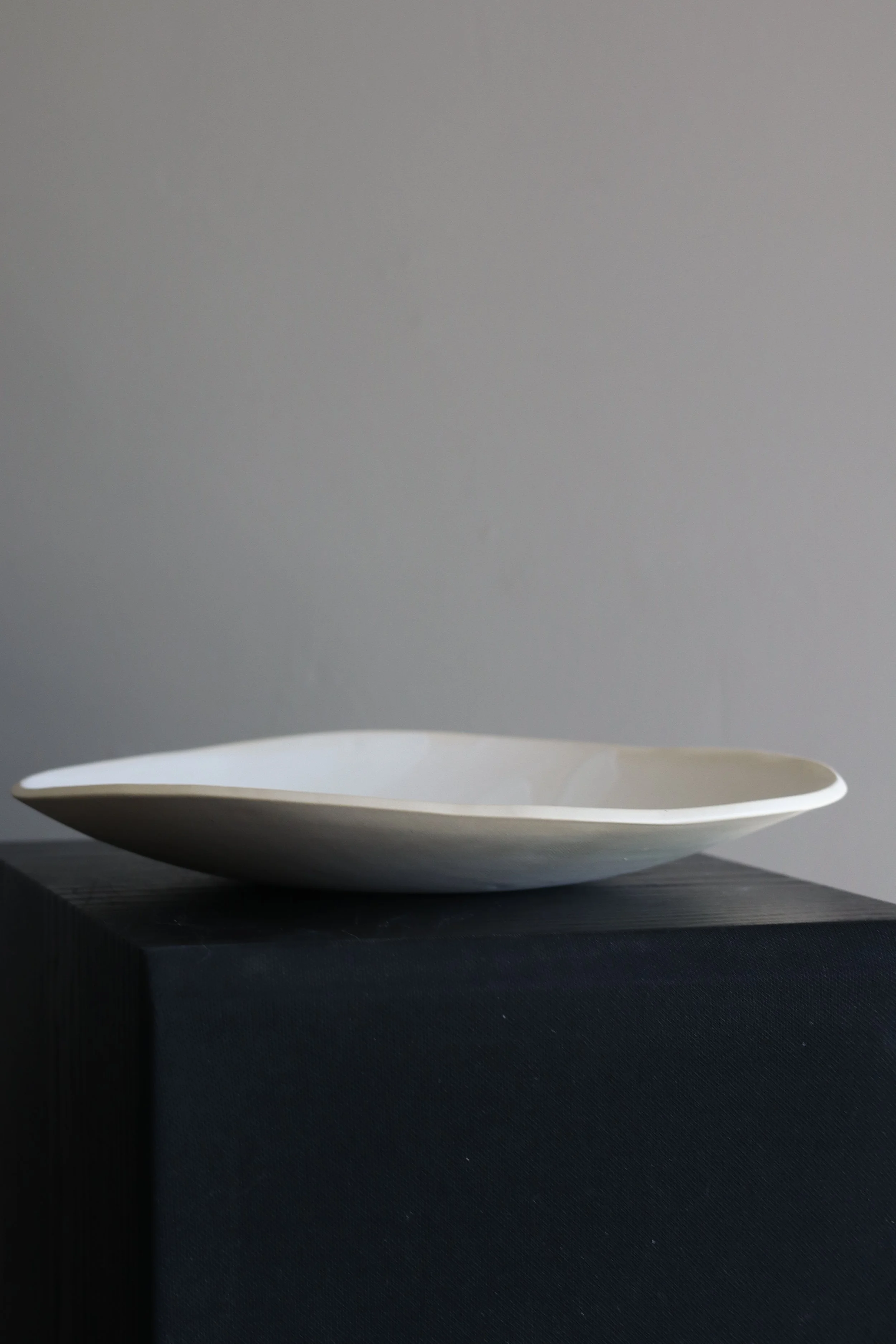
Made with Buff Stoneware Clay and a hand poured matte white mineral glaze. These organically edged vessels are both stunningly beautiful and fully functional as vessels for food.
28cm x 4 cm
Wabi-sabi is a Japanese aesthetic that embraces the beauty of imperfection and natural simplicity.
Wabi:
This part of the term refers to a sense of simplicity, modesty, and natural beauty. It can also be understood as a kind of "less is more" philosophy.
Sabi:
This refers to the beauty that comes with age and the passage of time, like the patina on a piece of furniture or the character in a worn-out object.
As with all handmade items, variation in size, shape and colouration is inevitable and part of the inherent charm of the product.
Dishwasher, Microwave and Oven safe.
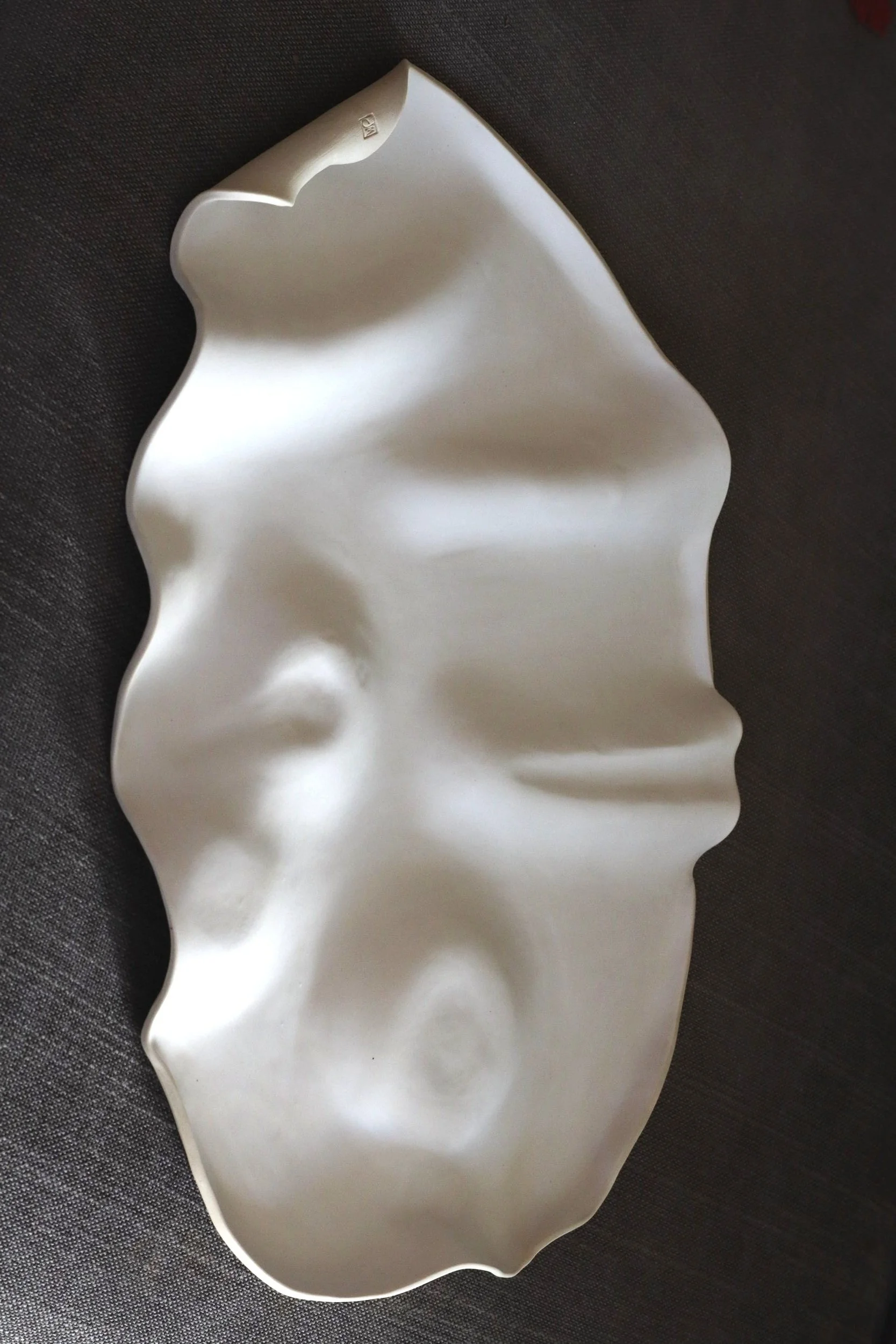
Made with Buff Stoneware and glazed in a simple Matte White glaze, this extra large platter is a one of a kind piece and the ultimate statement piece for your next social gathering.
Inspired by the rolling hills and escarpment landscape in winter, here where I live in Glen huron, ON. Use the hills, valley and plateaus in this piece to layer and give height to your charcuterie.
*An extremely hard piece to create, taking over a month of forming and slow drying, before going through two kiln firings with extra special care and lots of crossing of fingers and toes. Every hill, valley and plateau was meticulously hand crafted.
L43cm x W55cm
(17” x 22”)
Hand wash only. Use “Barkeepers Friend” to remove cutlery marks.
*SHIPPING SURCHARGE WILL APPLY FOR THIS OVERSIZED ITEM. I will contact you with the additional amount post checkout.
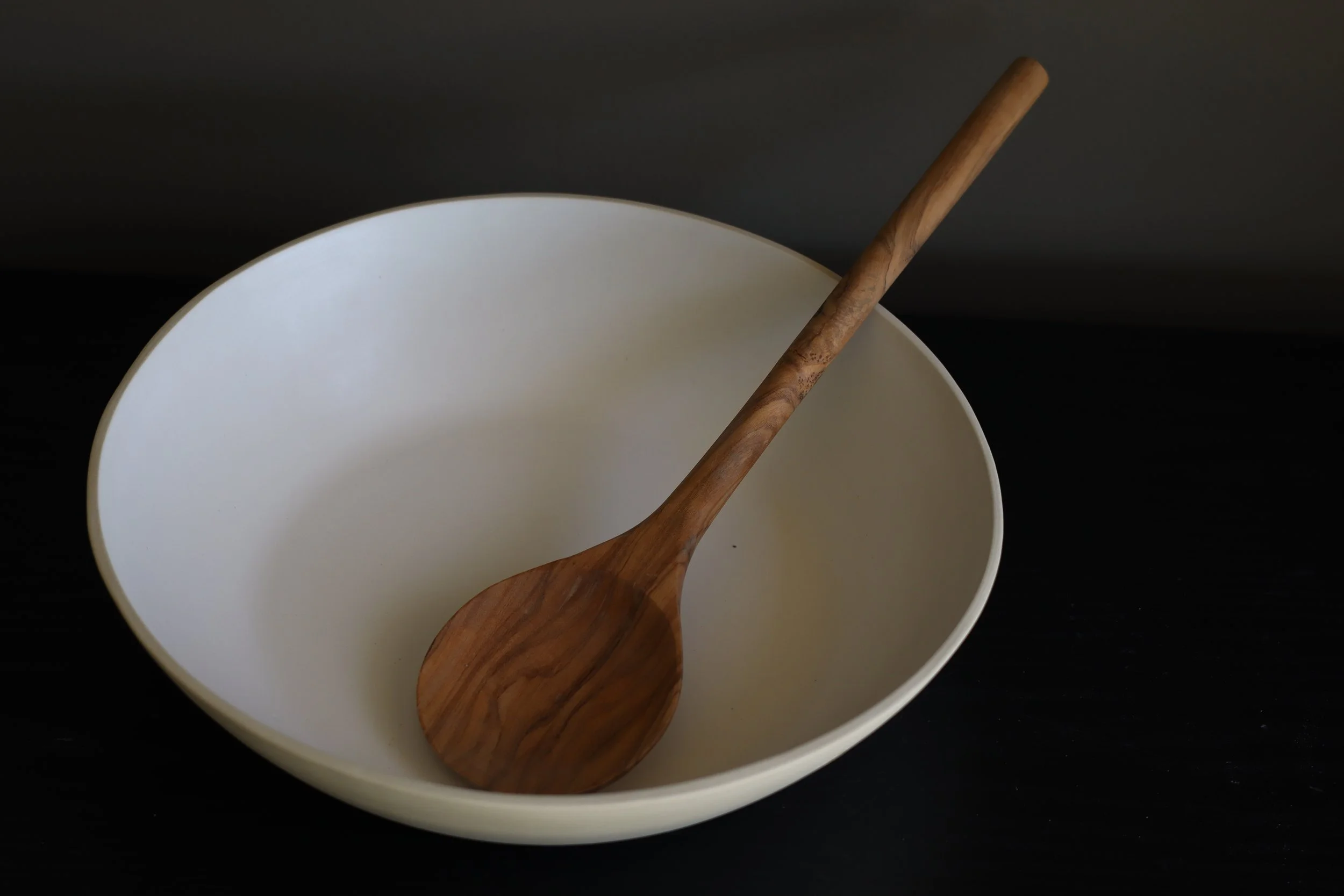
A generous serving bowl in Exposed Buff Stoneware and a Matte White Glaze on the interior. Hand formed with organic edging.
This bowl pairs perfectly with the organic dinnerware collection.
26cm x 6cm
As with all handmade items, variation in size, shape and colouration is inevitable and part of the inherent charm of the product.
Dishwasher, Microwave and Oven safe.
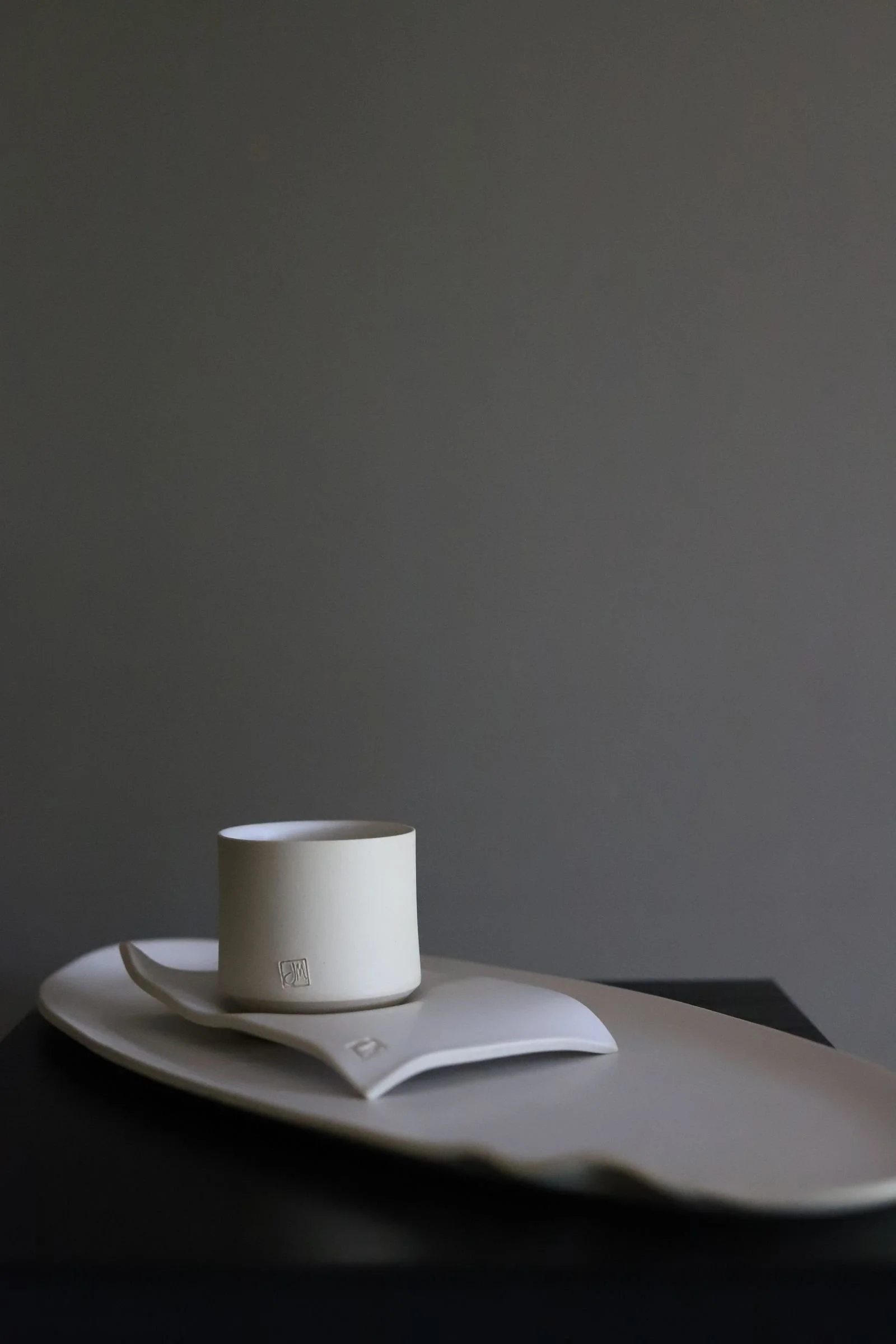
Hand formed in Buff White Stoneware with a Matte White glaze topper.
In stock or Made to Order.
Although dimensionally similar, the organic edges of these pieces make every piece unique and let the properties of the clay speak for itself. Platters pair perfectly with either the round dipping bowls.
37cm x 17cm
As with all handmade items, variation in size, shape and colouration is inevitable and part of the inherent charm of the product.
Stackable, microwave, oven and dishwasher safe.
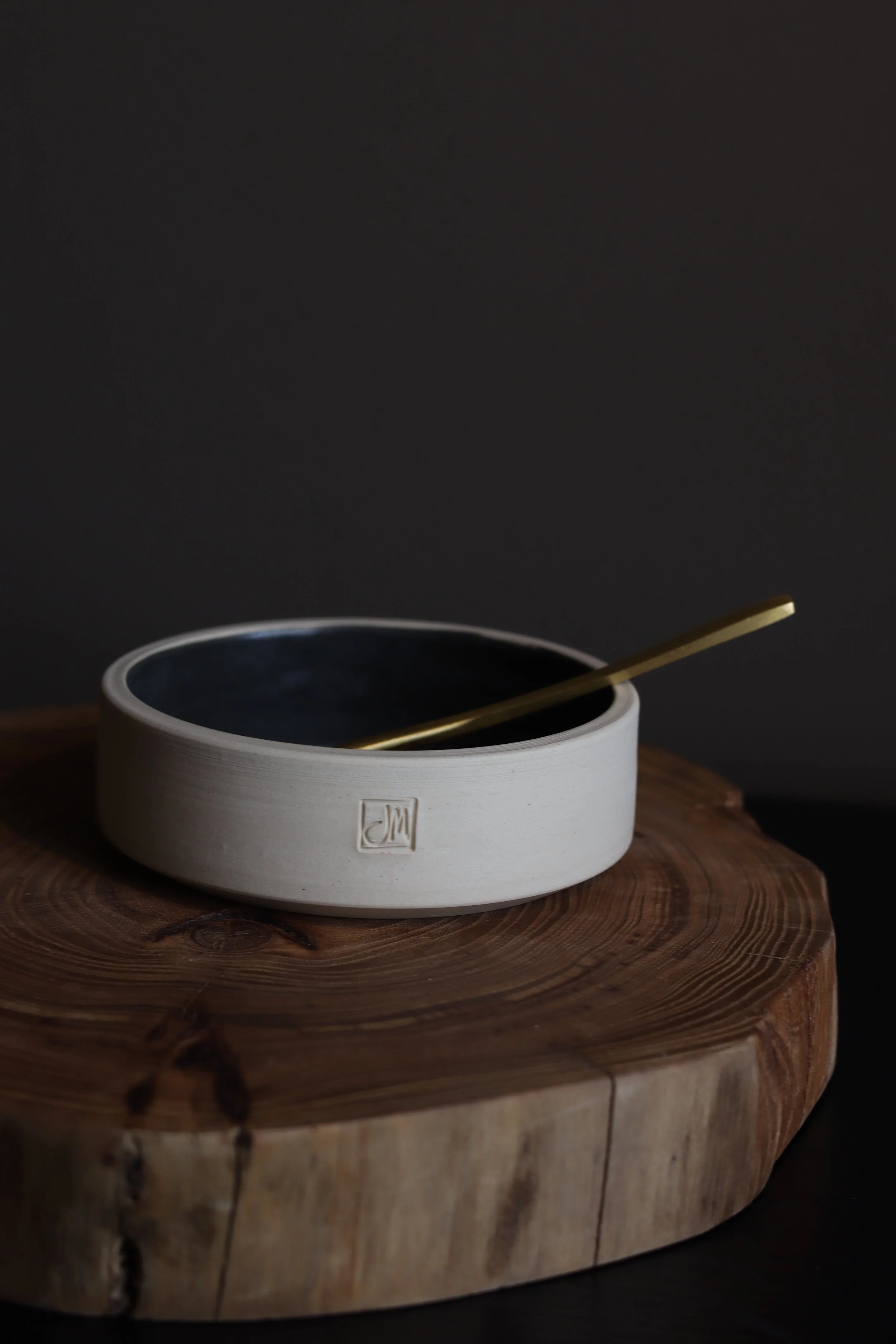
A contemporary cylindrical all-purpose vessel. Buff White Stoneware and a variety of coloured interiors. Perfect for pairing with the Ripple Platter to use for dips and spreads in a charcuterie arrangement.
Also perfect as: A wine bottle rest for the table; A dish soap/hand soap bottle rest; A bedside jewelry dish; A pillar candle holder…
~10cm x 3cm
As with all handmade items, variation in size, shape and colouration is inevitable and part of the inherent charm of the product.
Dishwasher, Microwave and Oven safe.
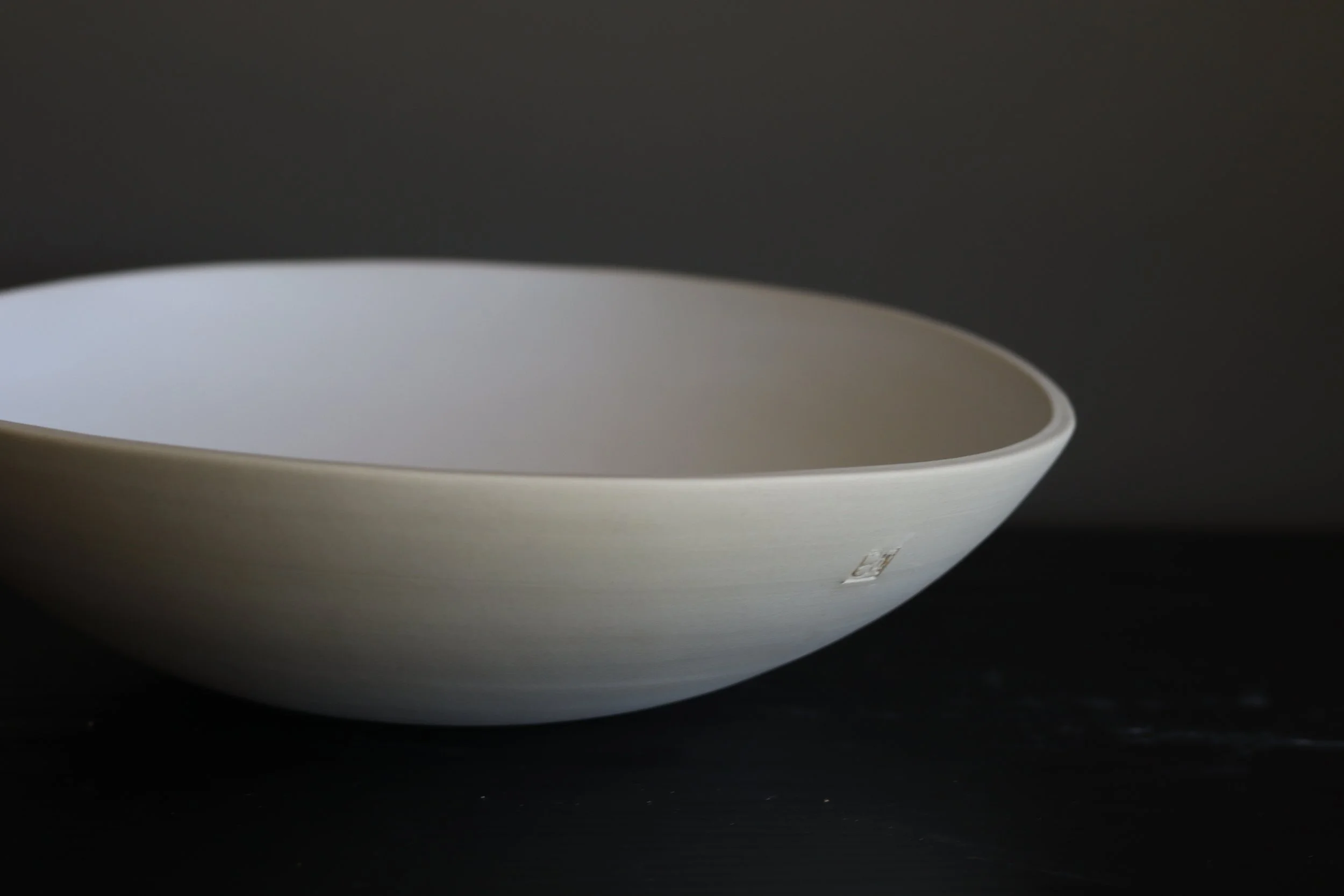
You’ll find these organically edged bowls served to you as part of Michelin Star The Pine Restaurants tasting menu. Buff White Stoneware with an matte white interior.
Limited edition bowls. Only 1 of each for sale here.
Bowl 1- Deep Bowl (24×6cm)
Bowl 2- Shallow Bowl (22×3.5cm)
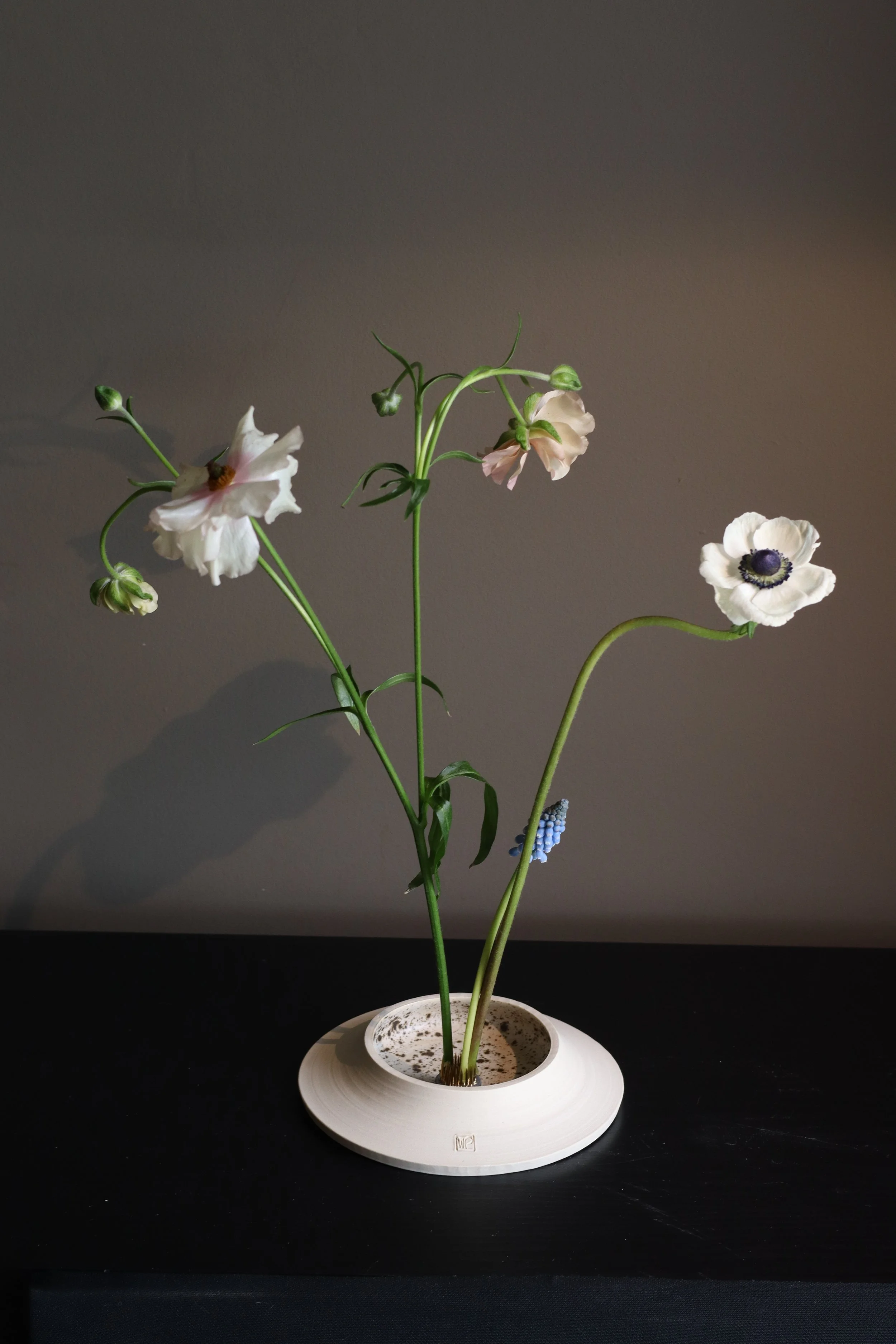
Inspired by the tasting plates made for the Michelin Starred Pine Restaurant in Creemore, ON. These fun little pieces can be used either way up. Ideas are limitless - share with me what you come up with!
Vessel 1- 16cm x 3cm (white and quail egg)
Vessel 2 & 3- 13cm x 3cm (iron lustre)
Use the interiors for-flowers, dips, jellies, nuts, etc.
Use the tops as- coasters, tasting plates, display pieces, etc.
As with all handmade items, variation in size, shape and colouration is inevitable and part of the inherent charm of the product.
Dishwasher, Microwave and Oven safe.
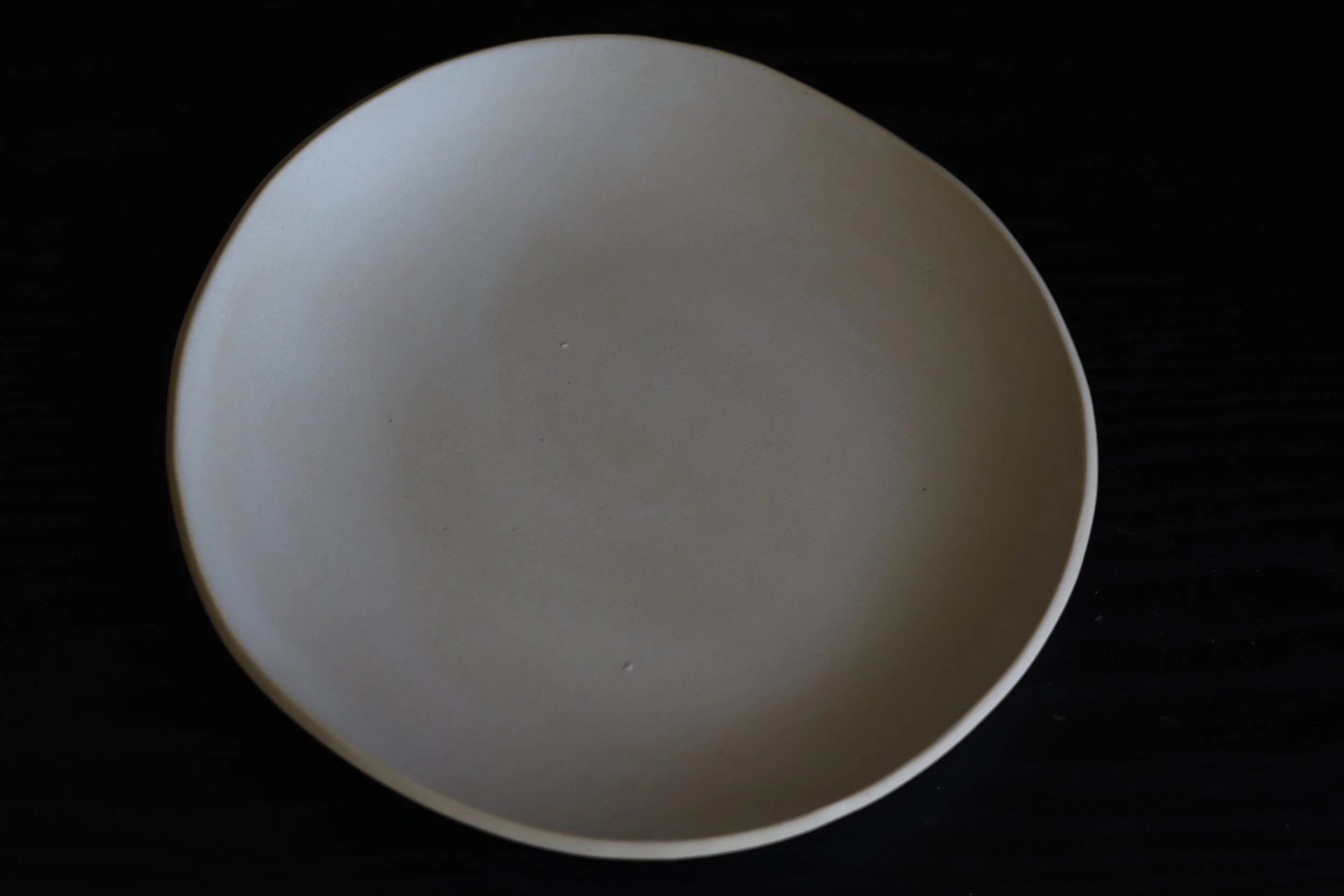
Made with Buff White Stoneware and either Matte White or Matte White Mineral glazes on the interiors.
Matte Mineral White Glaze
Bowl 1- 20×3cm (similar to wabi sabi bowls)
Bowl 2- 20×2.5cm (flatter bottom, organic edge, great pasta bowl)
Matte White Glaze
Bowl 3- 21×3.5cm (flatter bottom, organic edge, great pasta bowl; slightly larger than bowl 2)
As with all handmade items, variation in size, shape and colouration is inevitable and part of the inherent charm of the product.
Dishwasher, Microwave and Oven safe.
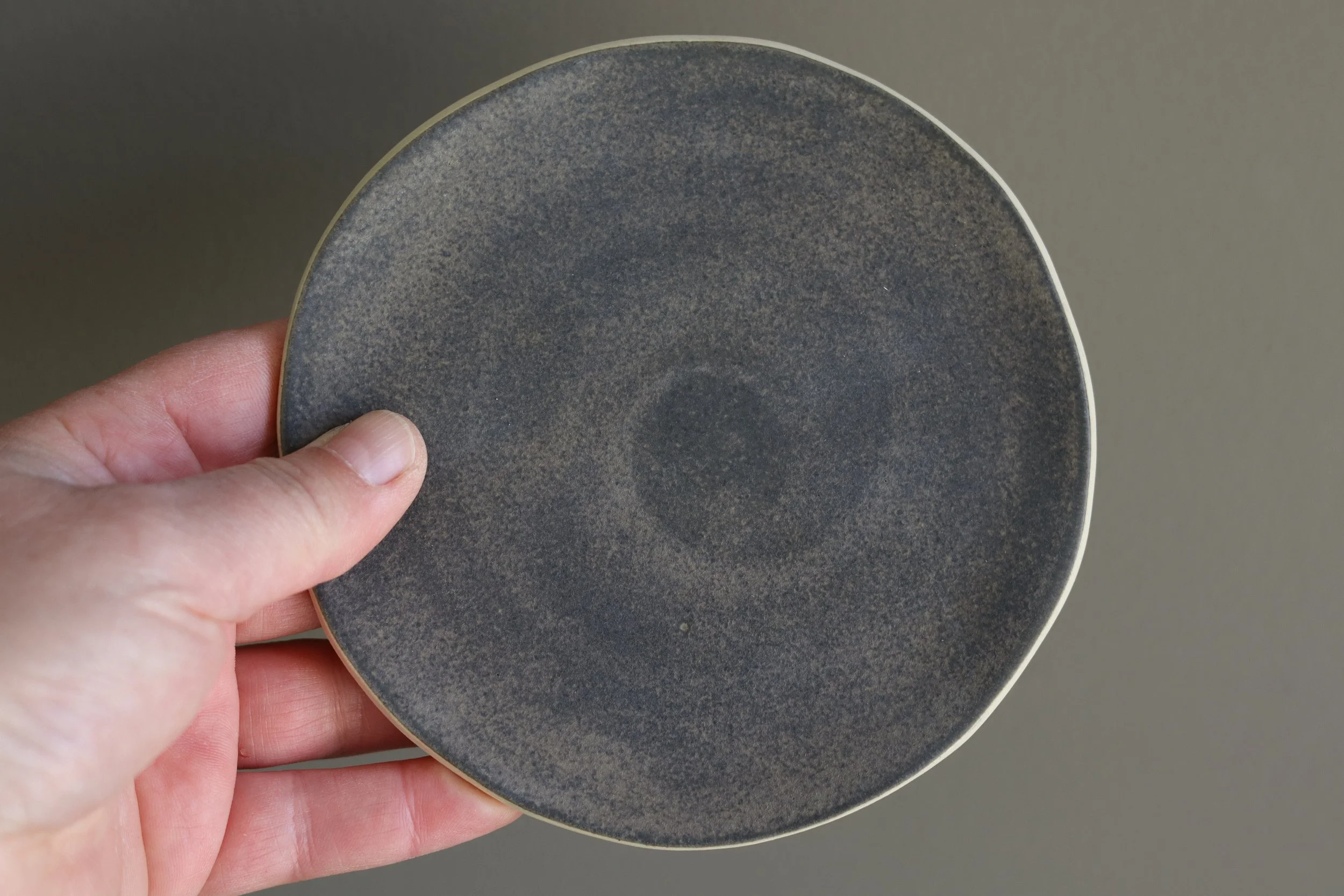
Buff White Stoneware exterior with a hand painted glaze topper. The perfect little side plate for every room of your home- think bedside jewelry, tasting plate, soap dish…the sky’s the limit.
13cm diameter
As with all handmade items, variation in size, shape and colouration is inevitable and part of the inherent charm of the product.
Dishwasher, Microwave and Oven safe.
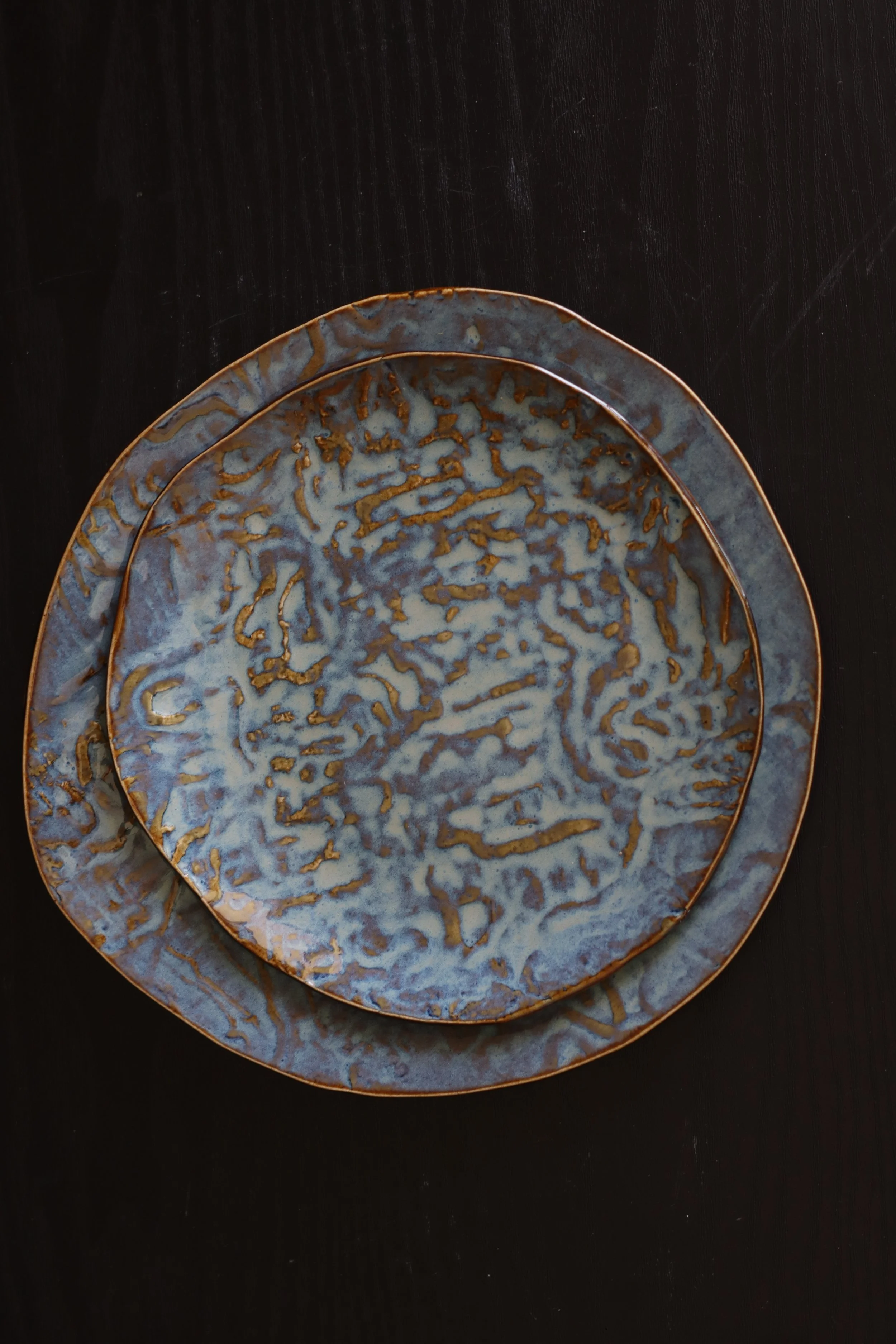
Buff Stoneware with a stunning Blue Rutile glaze that breaks brown over texture.
Food safe.
Created as an homage to the fallen ash trees on our property, caused by the emerald ash borer. The larvae, often referred to as "woodworm," bore into the wood, creating tunnels and consuming the wood as they develop. What is left behind is devastating, but also stunningly beautiful. This is what I wanted to capture in these very special pieces.
Plate 1- 21 cm diameter
Plate 2- 18 cm diameter
A nod to the Japanese Art of Impermanence: “An acceptance that there is beauty in imperfection, impermanence, and simplicity. It embraces the natural decay and aging of objects, seeing them as more beautiful and unique due to their history. It's a philosophy that encourages acceptance of flaws and a focus on the present moment”.
As with all handmade items, variation in size, shape and colouration is inevitable and part of the inherent charm of the product.
Dishwasher, Microwave and Oven safe.
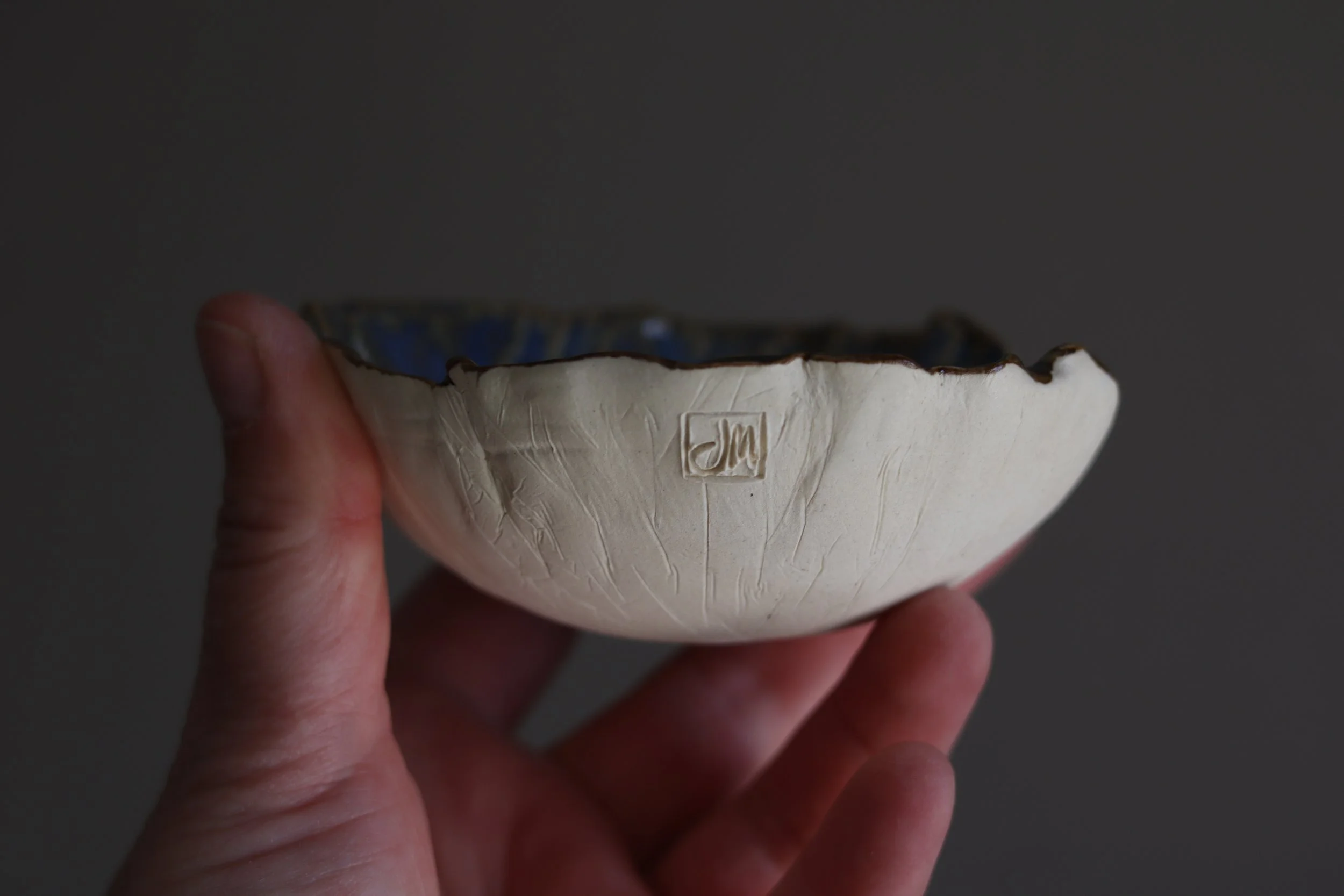
Buff Stoneware with a stunning Blue Rutile glaze that breaks brown over texture.
Food safe.
Created as an homage to the fallen ash trees on our property, caused by the emerald ash borer. The larvae, often referred to as "woodworm," bore into the wood, creating tunnels and consuming the wood as they develop. What is left behind is devastating, but also stunningly beautiful. This is what I wanted to capture in these very special pieces.
Bowl 1- 11cm diameter x 4cm wide
Bowl 2- 12cm diameter x 3cm wide
A nod to the Japanese Art of Impermanence: “An acceptance that there is beauty in imperfection, impermanence, and simplicity. It embraces the natural decay and aging of objects, seeing them as more beautiful and unique due to their history. It's a philosophy that encourages acceptance of flaws and a focus on the present moment”.
As with all handmade items, variation in size, shape and colouration is inevitable and part of the inherent charm of the product.
Dishwasher, Microwave and Oven safe.
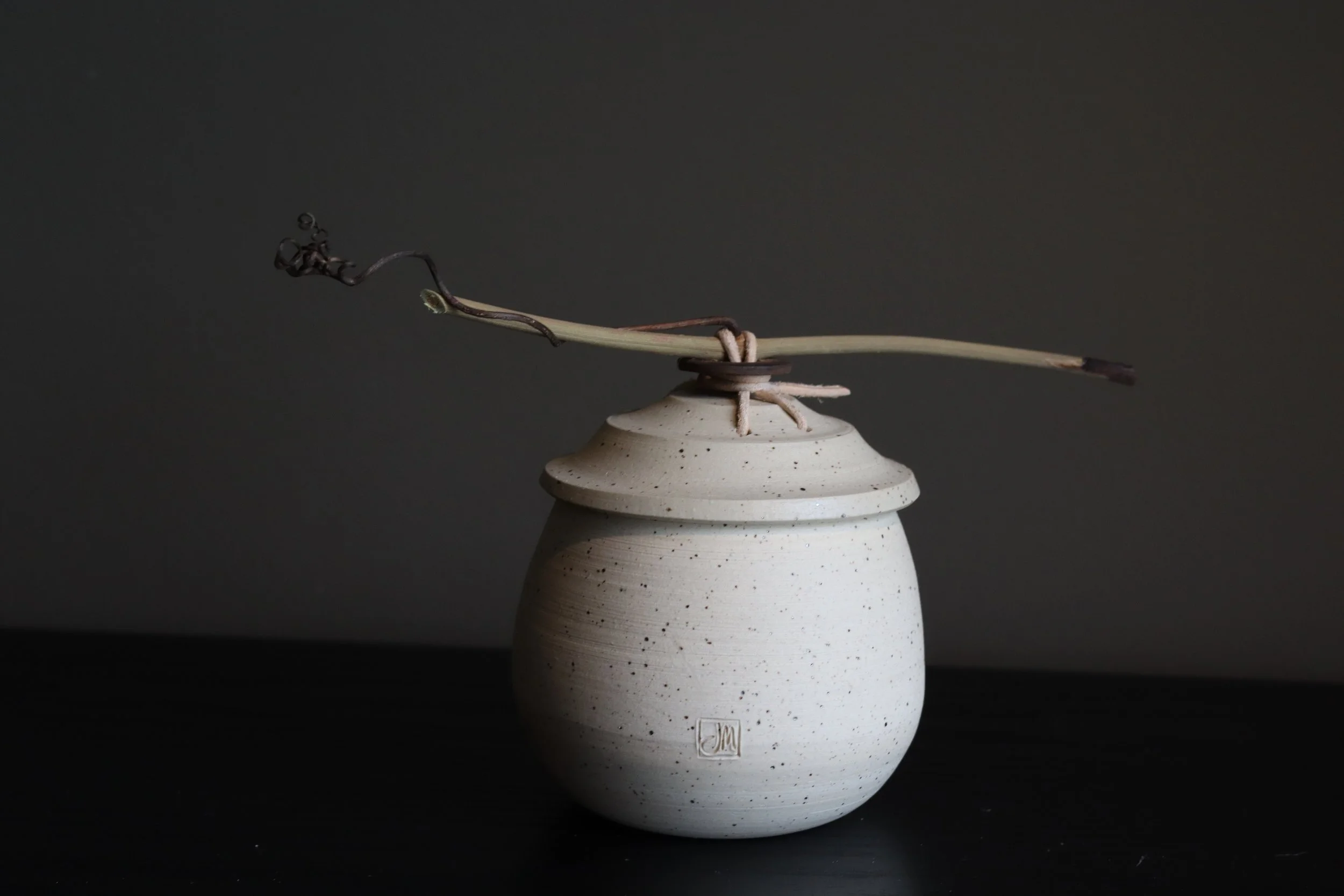
Wheel thrown from Speckled Stoneware and glazed with a farmhouse white interior. This One of a Kind vessel is functional and aesthetically stunning.
Display as a centrepiece on a shelf or use for everyday storage (think sugar bowl).
Topped with natural, foraged grapevine; an antique washer and ethically sourced leather cordage.
W10cm x H12cm
Handwash only.
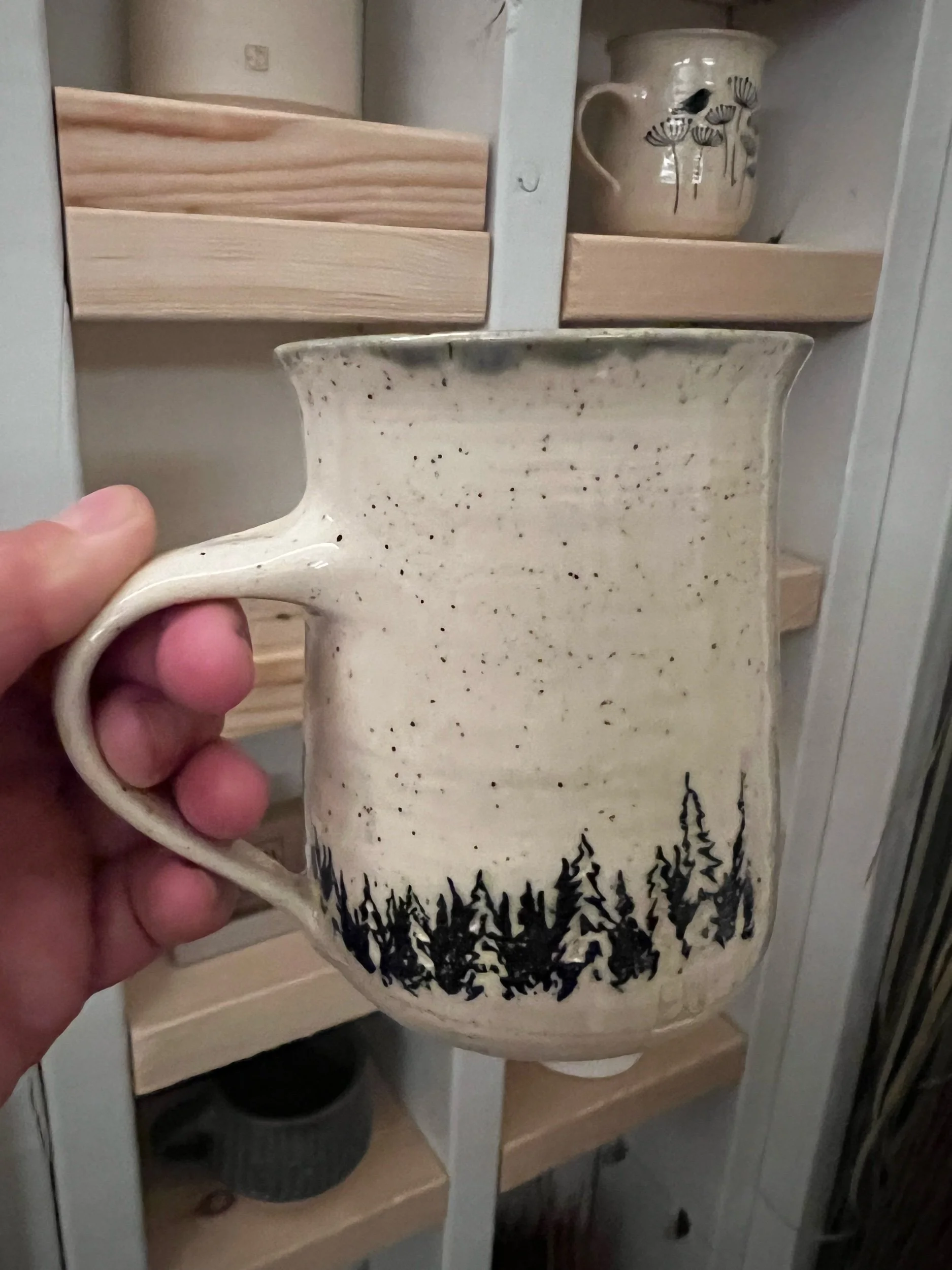
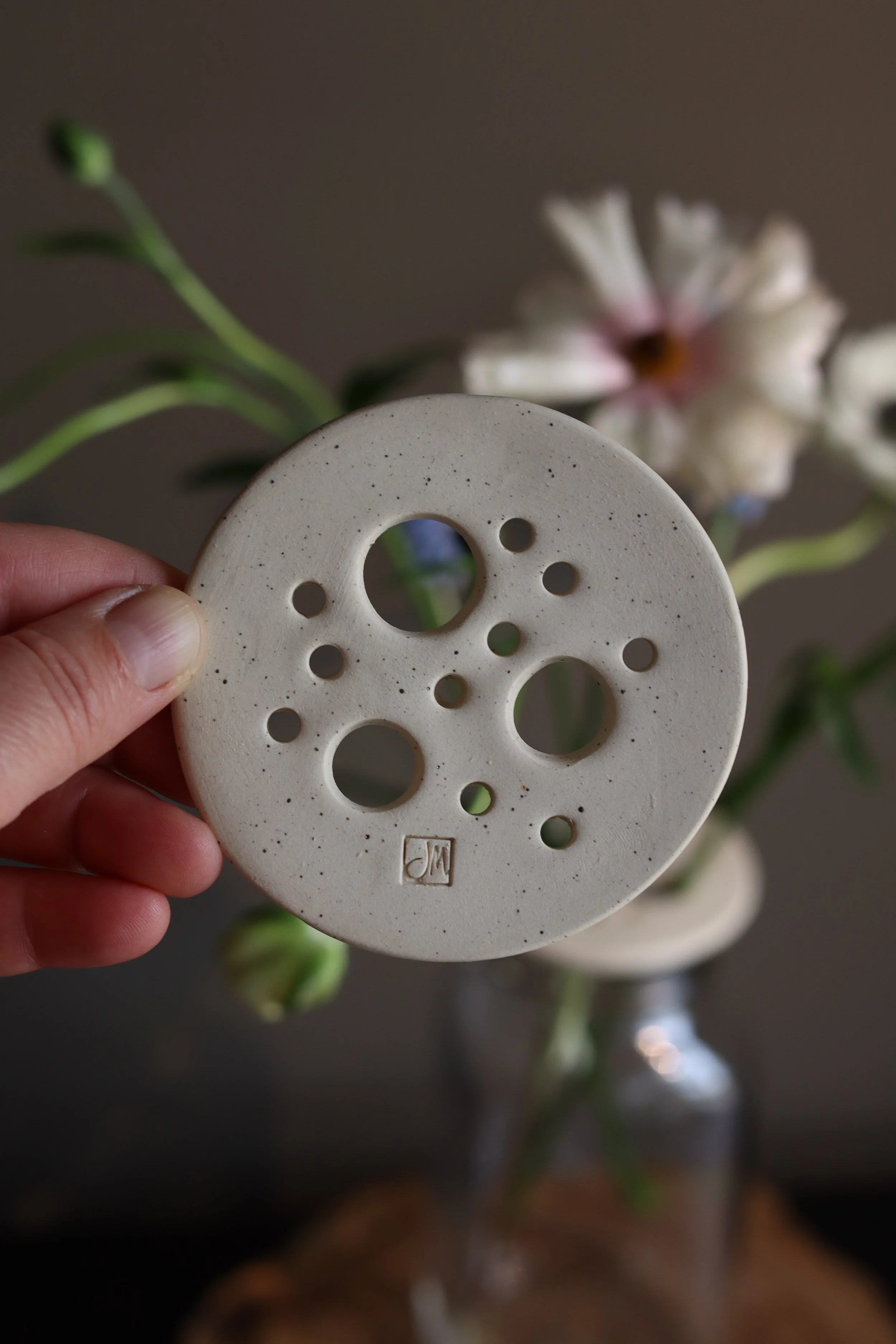
The perfect companion for any mason jar or vase. Simply place on top and add herb, bush or flower stems into the slots to keep them upright and separated. No more saggy flower bouquets!
Raw Speckled Stoneware.
8.5cm diameter
As with all handmade items, variation in size, shape and colouration is inevitable and part of the inherent charm of the product.
Dishwasher safe.
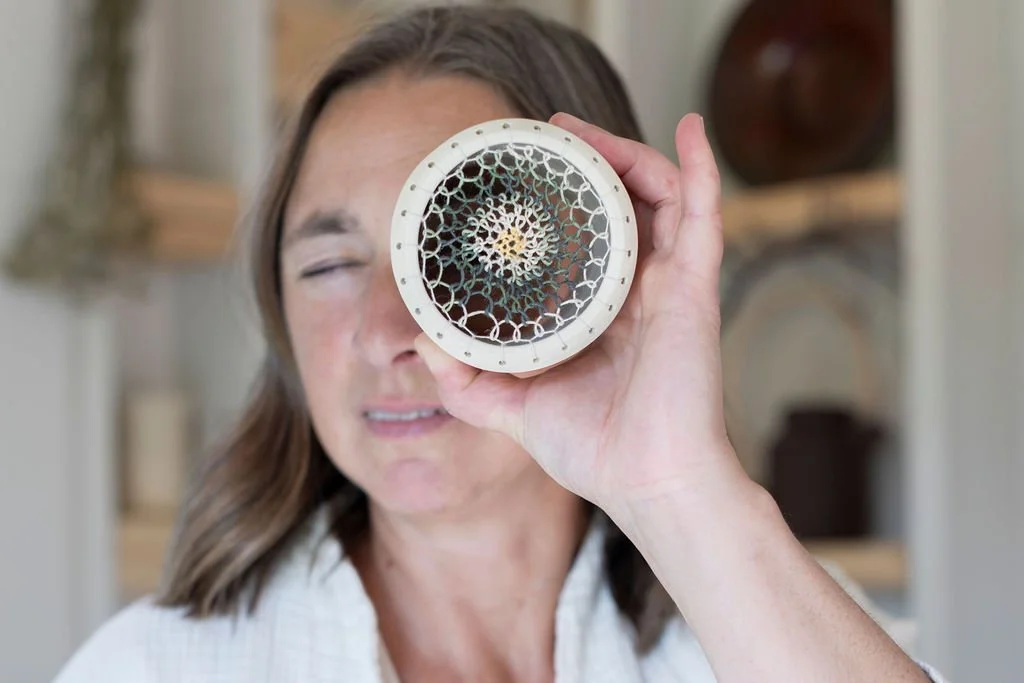
17”D x 5”H
Hand-formed in stoneware and finished with a food-safe glaze, Organic Edges draws inspiration from the shelf fungi and lichen that quietly inhabit the forests of the Niagara Escarpment and the Canadian Shield.
Its ruffled rim and textured surface echo the layered growth of these resilient organisms, celebrating the beauty of forms shaped by time, weather, and symbiosis. Rooted in a wabi-sabi sensibility, the vessel embraces asymmetry and imperfection as expressions of nature's quiet wisdom.
Both sculptural and functional, Organic Edges invites us to find wonder in the overlooked—to discover that beauty often grows at the edges.